
In an increasingly challenging production environment, achieving even incremental performance improvements can have a substantial impact on final profitability. The primary goal of the poultry breeding industry is to produce the maximum number of viable, robust chicks.
This naturally relies upon optimising the quantity of fertilised eggs and the size classification of these eggs. In recent decades, genetic selection for rate of lay and egg size has substantially improved production, however, selection for high meat yield in the progeny is negatively correlated to reproductive fitness traits in the breeders increasing the complexity of optimising breeder production.
For this reason, genetic improvement may have reached its limit. Consequently, the industry must identify other areas that can impact reproductive fitness.
Optimal gut health and breeder performance
Good gut health is increasingly recognised as essential for both health and performance. Numerous studies have found links between gut health and egg production/egg size/persistency of lay, which is thought to be related to interactions between microbiota-gut-liver/brain-reproductive tract axis.
Almost regardless of cause, a downturn in gut health is likely to result in reduced capacity to uptake nutrients. For example, coccidiosis can lead to gut lesions, damaging the villi on the absorptive surface and reducing nutrient absorption. The presence of antinutritional factors such as non-starch polysaccharides causes digesta to be more viscous, reducing gut transit, sloughing villi and reducing nutrient availability and absorption. Imbalances of the gut’s microbiota can allow the proliferation of pathogenic microbes, causing diarrhoea and/or inflammation, again reducing nutrient absorption. Unlike broilers, the breeder bird must partition of nutrients between their own maintenance and performance, and the deposition of nutrients in the yolk sack of the ova for females, or semen quality in the males.
As such, optimal gut health is essential to facilitate nutrient absorption. Historically, the use of antibiotics to both treat and prevent disease has masked many of the issues that we now recognise as factors that affect gut stasis. However, with ever-increasing evidence of antimicrobial resistance, we need to dramatically reduce our reliance upon antibiotics and seek alternatives. Whereas an antibiotic is designed to kill microbes, probiotics directly supply microbes believed to be beneficial to the gut, manually supporting the colonisation of these potentially beneficial microbes. However, as with antibiotics, we know that bacteria mutate, potentially altering their function. We are already starting to see research demonstrating potential pathogenicity and antibiotic resistance to some common probiotic strains, so maybe this is not the right approach either.
Eubiotics
Eubiotics provide a new approach to maintaining a favourable gut environment. Rather than manually manipulating the microbes in the gut as with anti and pro-biotics, eubiotics support the favourable microbes in the gut, facilitating the establishment of a balanced, healthy intestinal microbiome.
By achieving this, eubiotics help the host to prevent the occurrence of pathogenic colonisation and subsequent physical damage to intestinal structures, facilitating optimal functionality of the gut and therefore optimal absorption capacity.
Oregano Essential oil
Oregano essential oil (OEO) is a eubiotic that has been widely researched and shown to support optimal gut function due to its antimicrobial, antioxidant and antiparasitic activities. Essential oils (EO) form the basis of a plant’s defence mechanisms, acting as a type of immune system. EO is comprised of numerous compounds that each offer a function to protect the plant from microbial or physical attack.
Oregano essential oil contains over 100 different compounds including carvacrol, thymol, β-caryophyllene, linalool, γ-terpinene and ρ-cymene. The avian gastrointestinal tract is a complex and diverse organ, with both active and passive involvement in numerous systems and processes. As such, no single compound is likely to improve every aspect. The complex composition of OEO facilitates its multi-factorial activity on multiple gut processes and immune challenges, therefore allowing the gut to function optimally, maximising absorption capacity and therefore optimal performance and minimal nutrient wastage.
Fertility and Laying Performance
The impact of gut health on reproductive performance is widely shown in both male and female breeders. Soliman et al., (2016) compared an untreated control to birds supplemented with Orego-Stim® (OEO-Based supplement) at 300 and 600g/t. The authors found that both inclusion rates of the OEO-based supplement significantly increased the fertility rate of the males, and the hatchability of fertile eggs compared to the control (Fig. 1).
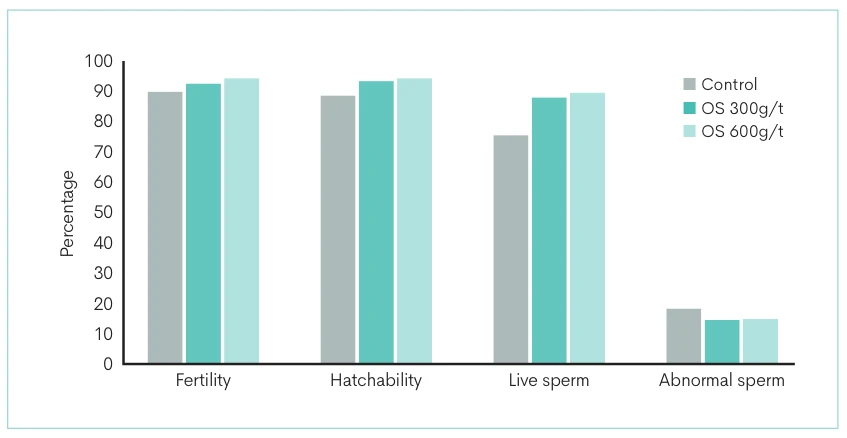
Likewise, the number of live sperm was significantly increased, and the number of abnormal sperm was significantly reduced. The total number of sperm in the ejaculate and total volume of ejaculate were both also significantly increased compared to the control (data not shown). Spermatozoa has a high content of phospholipids that are highly prone to oxidation. As such, the antioxidant capacity of the oregano essential oil is likely the driving force behind improved semen parameters. Female breeder performance was also impacted with egg production per hen throughout the trial being increased by 3.8% for the 300g/t inclusion rate and 5.17% for the 600g/t inclusion compared to the untreated control.
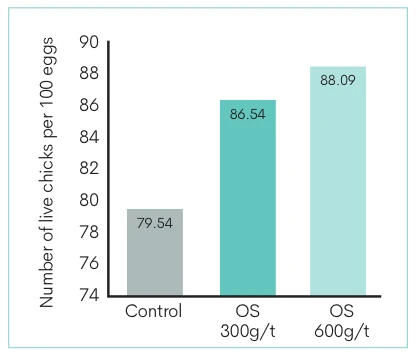
When the number of live chicks hatched per 100 eggs laid was compared, the group supplemented with 300g/t of OS achieved an 8.8% increase, whilst the 600g/t group achieved a 10.75% increase in the number of live chicks hatched compared to the untreated control (Fig. 2).
Economic Impacts
The economic impact of many supplements is something that is sometimes overlooked and not fully extrapolated. However, in a market with increasingly small returns, the investment we make in both the diet and any additives utilised can make the difference between profit and loss. Therefore, full economic analysis is essential. When we look at the economics of these results in the context of commercial production, actual feed intake, number of eggs laid per hen and percentage of eggs producing live chicks per treatment, the results show that the supplementation of the OEO-based supplement at 300g/t resulted in an additional profit of $40.54 per hen per 16-week cycle (24-40 weeks of age).
For the 600g/t inclusion of the OEO-based supplement, the economic analysis found an additional profit of $51.42 per hen, per 16-week cycle (24-40 weeks of age) (Table 1).
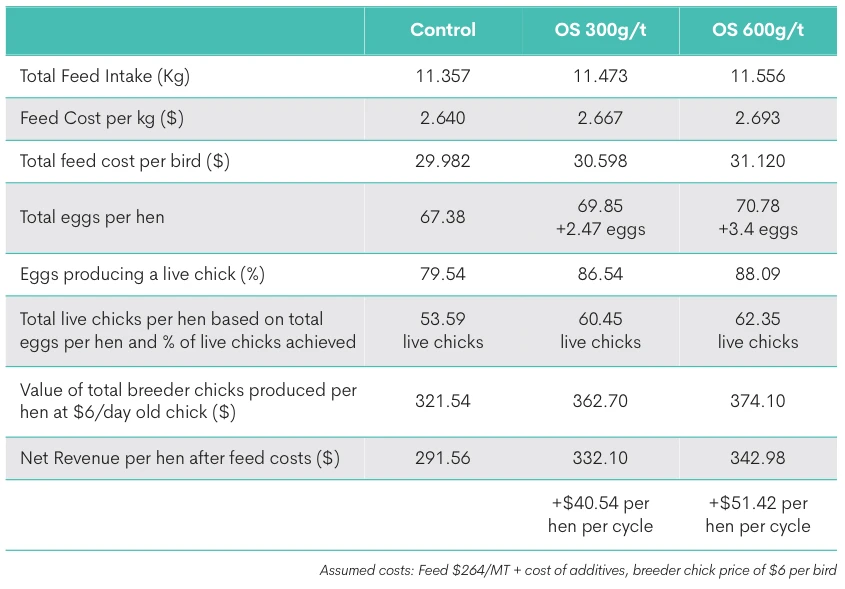
This additional profit achieved, once the cost of feed and additive is fully accounted for is substantial and demonstrates the value that an effective additive can bring to production.
Summary
There is no magic behind the efficacy of oregano essential oil with decades of scientific research and validation, demonstrating the role it can play in supporting health and reducing the need for traditional antimicrobials. However, with spiralling costs, it can be tempting to remove health supplements from our management strategies. Research consistently shows that optimal gut health not only facilitates optimal animal performance but also reduces the need for antibiotic intervention, thereby helping to reduce the threat of antimicrobial resistance. Orego-Stim is proven to support gut health, reducing the incidence of disease whilst supporting reproductive performance. As such Orego-Stim can support the efficiency and profitability of breeder production.
References are available from the author on request
