Sow performance is often given as piglets born alive or piglets weaned per sow per year. In general, a sow only becomes profitable after her third litter and reaches her maximal productivity between parity 3 and 5. Thus, ensuring sows reach at least parity 3 and keeping as many sows as possible healthy and productive until their 5th litter is as important as litter size for optimal performance of sow herds. At the same time, current recommendations suggest an annual replacement rate of 40-50% to keep the balance between profitability and genetic improvement.

Sow Mortality
In recent years, sow mortality rates increased significantly. There are reported increases from 7.9% in 2012 to 13.6% in 2021. In a study published in 2023 examining sow mortality in the US, 50% of all dead or culled sows were at parity 2 or less. The main mortality reasons described for several countries and production systems are lameness, reproductive issues including prolapses and sudden deaths. Each surplus replacement above the recommended rate has an impact on the farm’s overall performance, especially if it is to replace a young sow.
First of all, these sows did not yet make up for their rearing and acclimatisation costs. In addition, having to introduce additional gilts into the herd increases the disease risk by introducing external animals to the farm and increasing the number of gilts not yet fully adapted to the farm environment and its pathogens. Additionally, too many gilts in the herd lowers average sow performance. The latter is because first parity sows often have smaller litters, lower piglet survivability and lower fattening performance of their offsprings when compared to older sows.To ensure the longevity of sows, management, genetics, and nutrition need to work hand in hand. Management includes the proper rearing of gilts, their introduction to the farm on time so that they can develop adequate immunity and sow management during gestation and lactation. Nutrition should ensure proper skeletal development during rearing and mammary gland development without overfeeding the sows as too much body fat reduces fertility and increases difficulties during farrowing.
Improved bone mineralisation to reduce lameness
Lameness is among the top reasons for premature culling of sows. The origin of lameness can be infectious (e.g. chondronecrosis) or non-infectious (e.g. claw lesions). Lameness has a big impact on sow welfare. It is a painful condition which causes stress. This in turn negatively affects the uterine environment and fetal survival and might result in higher piglet losses. Thus, it can be assumed that some of the cullings for reproductive issues might in fact have been caused by a non-detected lameness. Besides selecting only gilts for breeding with a good fundament and healthy claws, nutrition to ensure proper skeletal development is key to reducing the incidence of lameness.
Bone structural material is mostly hydroxyapatite, which also forms the main body reserves for calcium (Ca) and phosphorus (P).
Therefore, sufficient, and balanced Ca and P supply especially during rearing is is essential. This is the reason why mineral and vitamin recommendations in general are higher for gilts than for fattening pigs. As a recent study found, inadequate Ca and P supplementation reduces bone mineral content in gilts within two weeks. Although these effects can be reversed by feeding adequate mineral levels, recovery takes at least four weeks. Furthermore it remains unclear whether there might be any long-lasting effects on the bones. Similarly, sows mobilise large amounts of Ca (and thus automatically also P) during lactation and have to replenish these stores again during the next gestation.
One of the most important elements in calcium metabolism is vitamin D. Vitamin D, either produced via UVB in the skin or ingested via feed, is metabolised in the liver to the circulating form 25-hydroxyvitamin D (25(OH)D3). Even though serum 25(OH)D3 concentration is used as a marker for vitamin D status, it is not yet the active form and thus does not give information on the effective physiological activity. To become metabolic active, 25(OH)D3 needs to be converted in the kidney to 1,25-dihydroxy vitamin D (1,25(OH)2D3), which is the active form of vitamin D. Under physiological conditions, 1,25(OH)2D3 is the only form exerting the biological actions connected to vitamin D. Among others, 1,25(OH)2D3 stimulates intestinal Ca absorption, Ca retention in the kidney and Ca deposition in bones. Additionally, 1,25(OH)2D3 is an important player in bone turnover, balancing the activity of osteoblasts (bone-forming cells) and osteoclasts (bone-resorbing cells) in bone tissue.
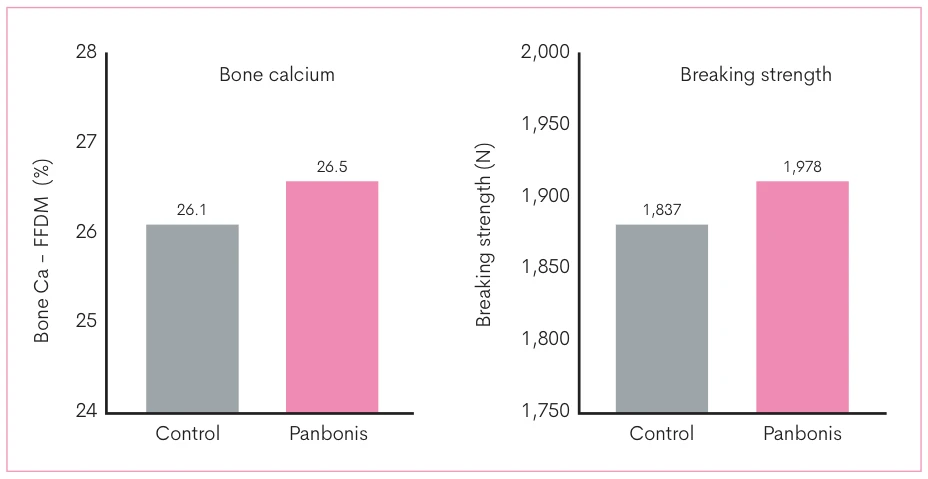
In a study with a total of 48 female fattening pigs (Piètrain x RA-SE hybrids), we could show that supplementing pig diets containing 2,000 IU/kg of vitamin D with 1,25(OH)2D3-glycosides from the plant Solanum glaucophyllum (Panbonis), increased tibia Ca content and breaking strength (Fig. 1).
This showed that even with sufficient basal vitamin D supplementation, fast-growing animals benefit from increased Ca absorption to support their skeletal development.
Supporting reproductive performance
The reproductive performance of sows includes multiple aspects: preparation of the uterus, providing an optimal environment for the embryos during gestation; easy farrowing and sufficient colostrum and milk production (both in absolute amounts and nutrient contents) All these factors increase the chance of survival of the newborn piglets. It becomes more widely known that 1,25(OH)2D3 as the active form of vitamin D not only impacts mineral metabolism but also many different processes in the body. Around the time of implantation of the embryo into the placenta, circulating levels of 1,25(OH)2D3 increase up to 3-fold. As there is no increased Ca requirement for bone formation in the embryo at this stage, researchers think that the increased levels modulate the maternal immune system to be more tolerant towards the ‘half-foreign’ embryo, while at the same time ramping up defences against pathogens.
Both mechanisms help to maintain pregnancy.
Supporting mammary gland development is an important piece of the puzzle to support the sow in producing sufficient milk for the piglets. Studies in different mammals including humans have shown that 1,25(OH)2D3 is involved in different stages of mammary gland development such as ensuring proper cell differentiation. Proteomic analysis in samples of the mammary gland tissue taken from gilts on gestational day 114 fed a commercial diet as control or supplemented with Panbonis, showed clear differences in protein expression. The main differences were found in pathways such as for fatty-acid metabolism and general mammary gland development. This might result in increased colostrum and milk production and increased weaning weight of litters as observed in different trials.
In a Brazilian trial, a total of 120 DanBred sows were either fed a commercial diet with 4,000 IU/kg of vitamin D or the commercial diet supplemented with Panbonis from day 85 of gestation until the end of lactation. Piglets were weighed at birth and again 24 hours later to estimate colostrum intake. The birth weight of the piglets of sows fed the supplemented diet was on average 1.33 kg, which was about 50g heavier than the piglets from the control sows, whereas litter size was similar. Besides being heavier at birth, piglets from the Panbonis group also had a significantly higher colostrum intake (330 vs 258g/ piglet). The relative reproductive improvement with the supplementation of 1,25(OH)2D3-glycosides as Panbonis based on 10 sow trials confirms the benefits of such a metabolite in today’s swine commercial operations (Fig. 2).

Conclusion
Supporting the vitamin D metabolism of today’s highly prolific sows in different physiological stages with Panbonis from Solanum glaucophyllum is beneficial for the well-being and performance of sows. It thus helps in the efforts to improve the longevity of sows.