
In the wild, the turkey female begins to lay eggs in the spring, stimulated by the increasing day length. Once she has laid a clutch of eggs (10-15), a natural desire to incubate them takes over, and she will sit on the eggs until they hatch some 28 days later. This is known as broody behaviour, caused by a build-up of natural secretions of the hormone prolactin in the bloodstream. However, generations of selection have reduced the tendency of female turkeys to become broody. Nevertheless, without proper management, broodiness can still significantly impact overall egg production. This is most apparent in hot climates or where female housing, nest and management conditions are below standard.
Once a female becomes broody, she ceases to lay eggs, which is undesirable in commercial production where high egg numbers are required. Females will normally start to show signs of broodiness 3-4 weeks after the start of lay, where a sudden drop in egg production after peak lay is likely to be a clear indication that a problem has started. A big factor that can promote broodiness is hot weather, and the performance of a female turkey can be impaired by house temperatures above 20-25°C. Hence, it’s important to manage the house environment well during these periods. Egg production is often improved when there is a difference of at least 10°C between day and night temperatures. Maintaining this temperature difference is particularly important in hot climates to help control broodiness.
A few ways to manage the internal temperature of a house are as follows:
• Increase ventilation rates and lower thermostat settings at cooler times of the day to reduce latent heat and allow birds to recover from hotter conditions.
• Ensure all fans are in working order, belts are tightened and fan housings are kept free of dust.
• Minimise obstructions that may reduce airflow: trim vegetation around the sheds, clean vent openings to remove dust accumulation, and keep screens and light baffles clear of dust and feathers.
• Direct hanging fans so air flows across the birds. Air movement at bird level has a cooling effect by removing body heat from the birds; this can be achieved by providing vertical or ceiling-mounted circulatory fans (1 fan per 120m2 floor space, spaced 10-15m apart).
Females should be encouraged to lay their eggs in the nest boxes, as those that lay their eggs on the floor can be more difficult to manage and encourage other hens to lay on the floor. Pens should be evenly lit and designed with as few corners and shadows as possible to discourage floor layers. Early identification of those females going broody is essential if they are to be treated successfully and egg numbers maintained. The important signs are:
• The broody female will spend a large proportion of her time on the nest if permitted.
• When approached, she might display aggressive behaviours such as hissing, raising back/neck feathers, and pecking.
• If the female is picked up and the oviduct everted, an early sign of broodiness is the production of distinctive-smelling faeces.
• As she becomes broodier, the oviduct becomes drier and harder to revert, and the pelvic bones move closer together with the skin between the bones becoming taut.

There are several systems that can be used to help identify broody females. The system chosen must be within the capabilities of the workforce because a system that is difficult to operate may not be done properly, or worse still, not done at all.
System 1: Inspection
All females found on the nest either first thing in the morning or last thing at night (at least 20 minutes after the last egg collection) should be inspected manually for broodiness. The birds can be inspected either in the nest (by palpation) or by removing it from the back of the nest so that the oviduct can be everted. It is important to prevent the potentially broody female from escaping the nest before it can be caught and inspected; therefore, it is best to have one person in front of the nest to prevent this. With this method, it is necessary to have a nest box design that allows a bird to be either removed or inspected from the back of the box. This method cannot easily be used with automatic nest boxes, although a team of two people can palpate from the front of the nest and pass the broody female to a third person in the passageway. The main advantage of this method is that, with trained personnel, it is very accurate and does not remove too many non-broody females from the laying pen. However, a disadvantage of this method is that it does not provide early identification of non-physical broody signs and may not work as well as other systems in hot weather.
System 2: Spray Marking
All females found on the nest, either at the first egg collection in the morning or last thing at night (at least 20 minutes after the last egg collection), should be sprayed with a colour marker. The following evening or morning, any birds on the nests that have the particular colour marker used the night before can be assumed to be broody. However, if nest access is restricted at night, then spraying at night will not work.It is best to remove all marked females found on the nest, as this system is based on nesting behaviour and as such gives an early indication of broodiness. Each day a different colour can be used, although the disadvantage of this is that the females can become multicoloured, making correct identification of the colour for the day difficult. It is, therefore, important to use colours that will not persist too long, such as dilute food colourants.

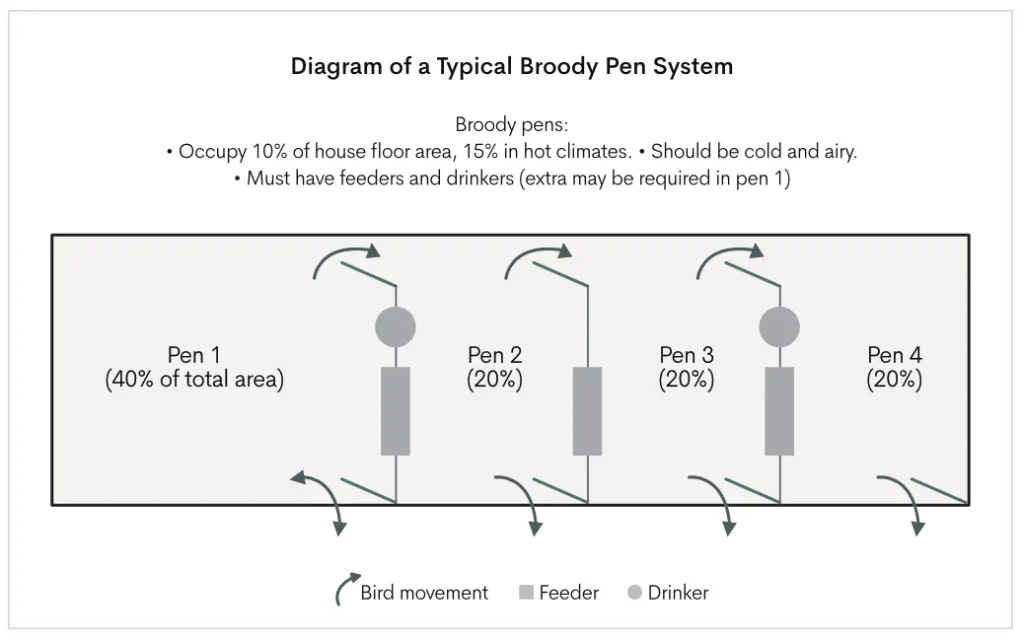
Having identified broody females using either one of the two methods described above, the broody females must be moved from their favoured environment (a warm, dark, comfortable nest) to an uncomfortable area without a nest known as a broody pen. The broody pen usually consists of a series of pens situated in the coolest part of the laying house and preferably with a higher light intensity than the normal laying pens. Up to 10% of the house will be needed for broody pens, although this should be increased to 15% in hot climates. In larger laying houses, the total broody space can be divided into two sets of pens. Each pen will ideally have a different floor or floor covering (sand, shavings, concrete, wooden slats, etc.) than the main laying pens and must be equipped with adequate feeding and drinking space, as deprivation of either will permanently stop broody females from returning to egg production. A four-pen system is used as illustrated below. Each pen should have easy (gated) access and be connected so that females can be moved from one pen to another daily. Allocate 40% of the area to the first pen, as this will receive the daily collection of suspect broodies that will be rechecked later and either moved to Pen 2 or returned to the laying pens.
Broody treatment is normally three to four days, after which females will normally start laying again, provided that they were identified as being broody early enough. The females in the broody pen should be inspected and handled daily, and any non-broodies returned to the laying pens. Likewise, any birds seen squatting or laying an egg should also be returned.
