
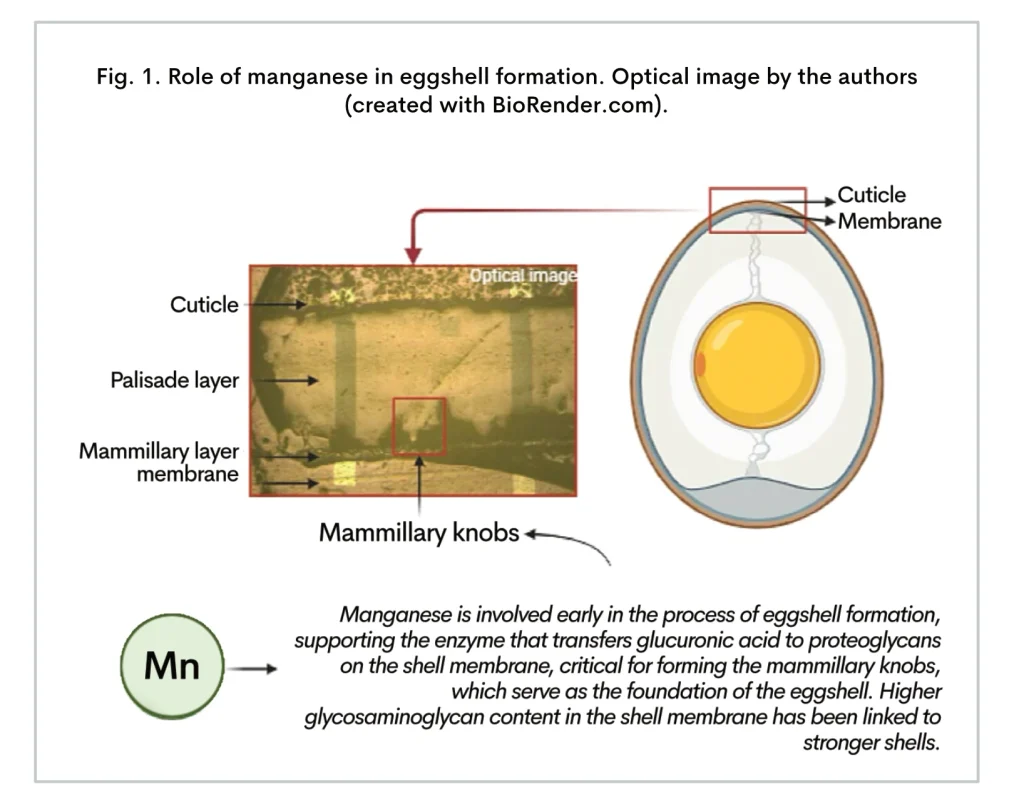
The formation of a complete egg takes approximately 24 hours from ovulation to oviposition. Early in this process, the shell membrane is formed – a stage where manganese (Mn) plays a critical role.
This article examines the role of this trace mineral and how it can affect eggshell quality, a key factor in both egg safety and economic value.
Formation of eggshell membrane and role of Mn in this process
Ovulation begins when the ovarian follicle ruptures, releasing the ovum into the infundibulum, where the vitelline membrane is added over a period of about an hour. In the magnum, albumen proteins are secreted over 3–4 hours, followed by shell membrane deposition in the isthmus (~1 hour). The egg then enters the uterus (shell gland), where water uptake shapes the egg and calcification of the CaCO3 shell occurs over ~19 hours. The final layer, the cuticle – composed mainly of water-insoluble glycoproteins – “seals” the shell pores, protecting the egg against pathogens while simultaneously permitting gas and moisture exchange. It is deposited in the last 1.5 hours. Within 15–60 minutes of oviposition, the next follicle is released and the cycle restarts.
Manganese functions as a cofactor in the enzyme involved in the transfer of glucuronic acid residues onto proteoglycans (particularly glycosaminoglycans) in the shell membrane during the early stages of eggshell formation. This process is critical for the development of mammillary knobs, which form the basal structure of the shell. Higher glycosaminoglycan content in the shell membrane is linked to improved shell strength.
Relationship between mineral solubility and mineral bioavailability
Traditionally, highly soluble mineral salts such as MnSO4 and ZnSO4 have been considered the most bioavailable and are routinely used as reference standards when determining the relative biological value of alternative trace-mineral sources. Recent data, however, demonstrate that the rate and extent of dietary mineral dissolution (i.e., its solubility) are not reliable predictors for intestinal uptake and utilisation. If we take calcium as an example: eggshell calcification begins in the uterus during the mid-afternoon to early evening. Crystalline CaCO3 is deposited on mammillary cores of the shell membrane and is built up into the highly organised columns of the palisade layer, which gives the shell its strength. This creates a high and sharp demand for Ca during shell formation. Because fine limestone particles dissolve rapidly, nutritionists often incorporate large-particle calcium sources to prolong calcium release in the digestive tract, ensuring availability during the night. This strategy helps reduce reliance on bone calcium mobilisation and supports stronger eggshell quality.
While Ca represents the main constituent of eggshell (95% of the matrix is composed of CaCO3), trace minerals are required for specific processes. Traditionally, trace minerals in layer hens’ diets dissolve quickly in the upper digestive tract, where they may interact unfavourably with calcium or phytate.
In contrast, slow-release mineral sources can bypass these interactions and be absorbed more efficiently in the small intestine. This improved bioavailability can lead to better shell quality, even at lower inclusion rates, compared to conventional sources.
Manganese solubility and eggshell quality
A 20-week laying trial in France evaluated whether Mn solubility correlates with bioavailability and its effect on eggshell quality. The study involved 936 White Leghorn hens (60 weeks of age), allocated into 12 replicates of 26 birds each, across three dietary treatments: (NC) a negative control, supplying only 43ppm Zn and 36ppm Mn from native minerals; (Zn), NC + 90ppm Zn from HiZox (Animine, France); (Mn), NC + 110ppm Mn from ManGrin (Animine, France). Eggshell fracture testing revealed a clear advantage for the slow-release ManGrin treatment compared to the other treatments (Fig. 2A). The effect of Mn was stronger than the effect of Zn supplementation.
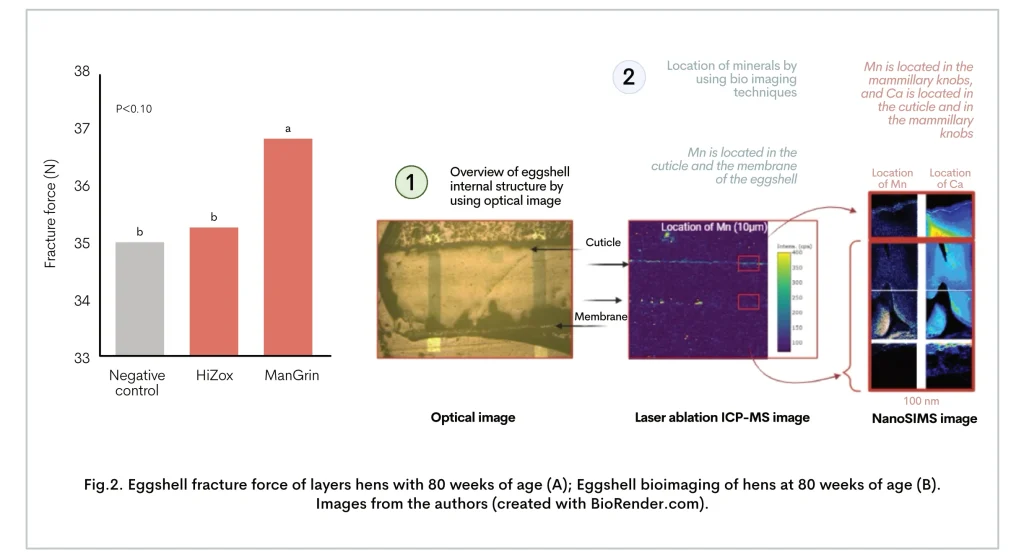
Complementary bioimaging (by IPREM), explored how minerals are incorporated into the eggshell structure. Results revealed Mn is located not only in the cuticle and in the membrane of the eggshell (yellow/green colours; Fig. 2B), but also in the mammillary knobs, supporting previous findings on the effect of Mn on the ultrastructure of the mammillary layer. Findings also suggested that the improved fracture force could be related to the Ca deposition in the eggshell (deposited in the cuticle and mammillary knobs; Fig. 2B), as observed in Mn-supplemented diets. This may be related to the impact of Mn on calcium-binding proteins. These findings suggest that trace minerals released more gradually in the upper gut are not less bioavailable than fast-dissolving ones and can significantly enhance shell strength in commercial layers..
Opportunities for laying hen nutrition
In summary, manganese supports eggshell strength more effectively than zinc does, and its effect is not driven by its solubility. It is the bioavailability, driven by the manganese’s release profile and its absorption in the gut, that ultimately determines its efficacy in supporting vital biological functions. Minerals that remain bound into the small intestine before release for absorption demonstrate advantages, enabling more efficient absorption and utilisation while minimising interference from other dietary components.For poultry nutrition, adopting slow-release Mn sources represents a strategy to improve shell quality, bird health, and economic efficiency while supporting welfare.
References are available from the author on request
