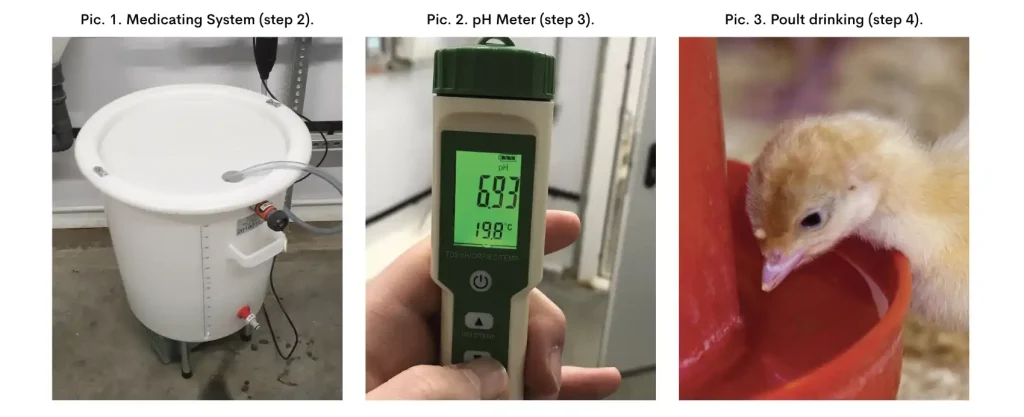
Water is an essential nutrient for birds. Providing a clean water supply throughout production promotes bird health, welfare, and performance, which is important irrespective of the production system used.
Water disinfection during production is an integral part of a good flock management system. Controlling bacterial contamination and biofilm formation in the drinking system is key to reducing bird exposure to harmful organisms and lessening the risk of disease spread.
Cleaning water lines between flocks
Before applying a daily water sanitation programme, it is important to thoroughly clean as much of the water supply system as possible to remove biofilm, scale, and other deposits. After the birds are removed, flush the lines with water. This will remove any loose sediment. Now fill the drinker lines with cleaning solution at the manufacturer’s recommended dilution rate. This can be done through a medicator or Dosatron. Once the water lines are filled with the cleaning solution, let it stand as long as possible, with 72 hours being best; however, check with the product manufacturer to ensure this will not damage the equipment. After the lines are cleaned, flush and refill with your regular in-flock sanitiser until restocking, so bacteria do not build back up.
Daily water line sanitation
Cleaning the water lines between flocks is only half the battle. Even with a thorough cleaning, if a significant number of bacteria, fungi, or yeasts are still present, then the biofilm has the potential to return completely in 2-3 days. Therefore, the last step is to establish a daily water and sanitation programme. This will benefit both the birds and the water system. The three most common sanitation systems are chlorine dioxide, chlorine with acidification, and hydrogen peroxide.
- Chlorine dioxide is a strong sanitiser made up of sodium chlorite and inorganic acid. It is an unstable form of chlorine that rapidly breaks down into harmless water and salt. The conversion is achieved by mixing the chlorite solution with citric acid, transforming the chlorite to chlorine dioxide.
- Chlorine with acidification is a system that kills organisms in the water using hypochlorous acid (HOCI) and hypochlorite ion (OCI). You must use two different medicators using both chlorine and acidification: one to pump in the acid and then one to pump in the chlorine. You should never mix the products in the same tank.
- Hydrogen peroxide products can also be very effective in sanitising your water system. Stabilised hydrogen peroxide works well on biofilms because it is a very good oxidiser and can break down the biofilm. In addition, it is non-corrosive to the drinker system and quite effective on bacteria, fungi, and viruses. It can break down algae thoroughly enough to allow it to pass through nipple drinkers without causing the nipple to clog or stick.
As well as continuous sanitising of the water lines, all bell-type drinkers must be washed with a disinfection solution at least three times per week. Wash the bell and bowl thoroughly with a brush or scrub pad. Wastewater should be poured into a bucket and removed from the house. Nipple drinkers should have a daily flush, which will keep water fresh and bacterial levels at a low level throughout the flock.
Measuring water line sanitation
An important piece of information to know how effective the sanitisation programme has been is the ORP value of the water; this can be done with a specific ORP reader, which is widely available. ORP stands for oxidation-reduction potential, and it is a great way to find out if the water sanitation programme is working.
A strong oxidiser literally destroys viruses, bacteria, and other organic material present, leaving the water microbiologically safe. An ORP value in the range of 650 and 700 millivolts indicates good-quality water. A lower ORP value, such as 250 millivolts, indicates a heavy organic load that will most likely overwhelm a sanitiser’s ability to properly disinfect the water. The bottom line is to utilise information on pH, ORP, and chlorine level to determine if the sanitation programme is effective and to also prevent equipment damage by the overuse of chemicals.
A couple of important points to note are that no sanitisers or any chemicals should be present in the water system when administering vaccines, medications, or vitamins, and do not mix different products in the same stock solution.
Step one – Choosing a sanitiser
Choose a sanitising cleaner that can effectively dissolve any biofilm or slime in the system. Some of the best products for this job are concentrated hydrogen peroxide solutions. Before using any strong cleaners, make sure standpipes are working properly so that air pressure buildup in the lines will be released. Consult equipment suppliers before using products to prevent unnecessary damage.
Step two – Prepare the sanitising solution
For the best results, use the products at the strongest concentration recommended on the label. Most medicators/dosatrons will only allow concentrations between 0.8 and 1.6% of the original material. If you need to use higher concentrations, it is better to mix the stock solution in the large tank and then distribute it without using a medicator or Dosatron. For example, if a 3% solution is required, mix three volumes of the cleaner with 97 volumes of water for the final solution
An excellent sanitising solution can be made up by using a 35% hydrogen peroxide solution. Mix this as described for a 3% solution.
Step three – Clean the lines
It takes 30-38 litres of water to fill and clean 100 feet of ¾-inch water line. If the building is 500 feet long and has two water lines, you should make up a minimum of 380 litres of sanitising solution. Water lines should be designed so that they can be opened to drain completely when the cleaning is done.
Follow these steps:
- Open water lines and drain completely.
- Begin pumping the cleaner through the water lines.
- Watch the water as it leaves the drain line for signs of the product, such as foaming.
- Once the water lines are filled with the cleaner, close the tap and leave the product in the lines for as long as the manufacturer recommends (over 24 hours if possible).
- Flush cleaner for the water lines after the holding period. Water used to flush the lines should contain the level of sanitiser normally used in the drinking water for the birds. In the absence of a standard water sanitation programme, add 113g of 5% bleach per 1 litre of stock solution and proportion this stock solution at the rate of 7.5g per litre of water. This will provide 3-5ppm of chlorine in the rinse water.
- After cleaning, sanitising and flushing the system, the water supply should be fresh and chlorinated (3-5ppm is the drinker furthest from the source). If using an ORP meter, the reading should be a minimum of 650.
- Lines that take water from a water well to the poultry houses should also be cleaned and sanitised between flocks. It is best not to flush these outside water lines through the water lines inside the buildings. Connect a water hose to the medicator tap to drain the outside lines.
Step four – Keep the system clean
- Once the system has been sanitised, it is important to keep it clean. Develop a good daily water and sanitation programme for your birds. The ideal water line sanitation programme should always include injecting both a sanitiser and an acid. It is important to note that this procedure requires two medicators or injectors since acids and bleach should never be mixed in the same stock solution.
- If only one medicator or injector is available, then inject bleach (concentration of 5%) at a rate of 40g per litre of stock solution. Proportion at 7.5g per litre of drinking water.
- The objective is to provide a clean source of drinking water with a continuous level of chlorine at 3-5ppm at the end of the building furthest from the medicator.