
Genetic selection for turkey hatchery performance aims to improve the efficiency of poult output and in doing so benefits global food security, sustainable use of resources and bird welfare. Primary breeders hold the pedigree lines used to produce the crosses used by turkey operations.
Individuals in pedigree lines are assessed for many characteristics of relevance to the supply chain from parent stock operations through to hatchery, commercial producers, processors and ultimately the consumer.
Genetic evaluation shows us that many biological traits are correlated, some favourably and some adversely. Balanced selection ensures genetic progress across all traits in the breeding goal.
Improving turkey hatchery performance requires selection for traits related to the following:
- Females must produce an egg which has a suitable environment for embryo development.
- Egg needs to be fertilised, which is influenced by male and female factors.
- The egg needs to be of good quality both internally and externally.
- The poult must successfully hatch from the egg and be of good health and quality.
Genetic selection relies on recording traits for improvement in individual birds with known pedigree. When it comes to measuring egg traits such as hatchability, the performance of eggs must be traced back to the contributing parents to allow a genetic evaluation of their performance to be estimated. Whilst hatchability and fertility are common metrics for assessing hatchery performance, breeders also use a wide range of correlated traits to enhance performance. Further, hatchery performance is dependent on the age of the parents, which requires data recording to be conducted across the reproductive lifetime of the pedigree birds.
Egg production and quality
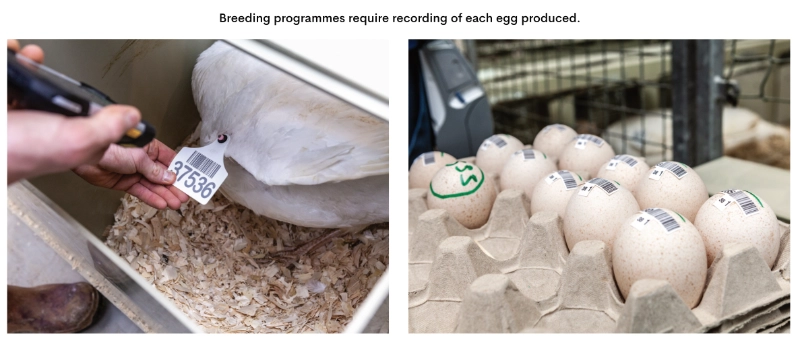
Hatchery planners require predictably good egg production to allow incubators to be filled to meet their supply chain demands. Alongside improving egg output, selection for breeder male and female liveability, health and welfare traits are important correlated traits. Selection for improved hatchery performance begins on the laying farm where every egg produced by the pedigree populations must therefore be 100% traceable back to its individual parents.
This requires robust procedures and reliable data capture technology. When the female is ready to lay, she enters a nest box with a trap front which holds her safely until her egg is collected. At collection, her barcoded wingtag is scanned, and the egg production is recorded alongside data on visual egg quality, and an identification sticker is placed on the egg. The eggs are stored in an environmentally controlled room and transferred weekly to the hatchery.
Over the reproductive phase of the flock, the total number of settable eggs produced by each hen is collected and used to generate an estimate of the breeding value for egg production. Handling of individual eggs allows for eggshell strength to be scored. Eggshell quality is assessed by specific gravity, or floating eggs in increasing salt water concentrations. Turkey eggs that continue to float in increasing salinity have higher hatchability, with a thicker and stronger shell that prevents too much weight loss during incubation.
Floor eggs are a potential source of bacterial contamination in the hatchery and reduced hatchery performance. Many hatcheries either do not use floor eggs or are highly selective about their use. In the breeding programme, the focus is on selecting birds with good potential to lay eggs in a nest so therefore, floor eggs are not recorded, and the egg production breeding value of hens laying floor eggs is penalised as a result.
Egg storability
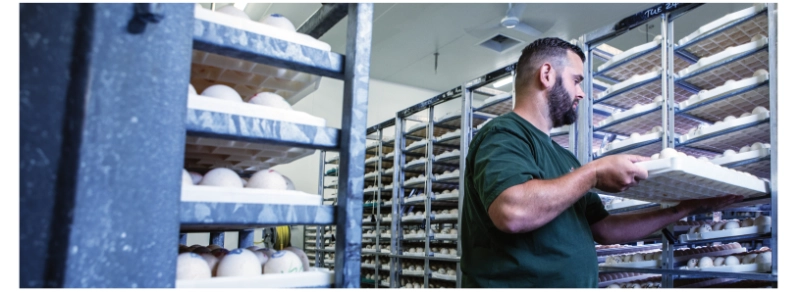
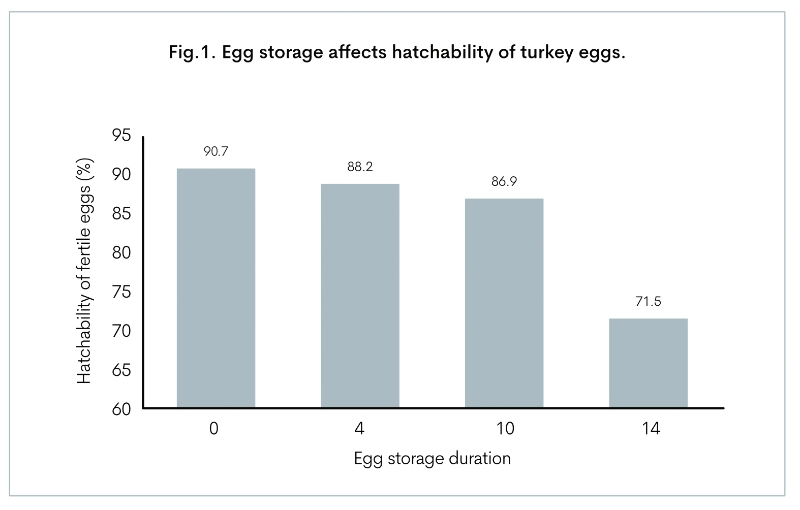
Hatching eggs are stored on farm and transported to a dedicated pedigree hatchery. Each week, eggs from a given pedigree hen are grouped. The pedigree hatchery mimics as much as possible a regular commercial hatchery but needs specialised staff and equipment to make the required measurements for the breeding programme. It is well documented that hatchability of turkey eggs declines with storage duration.
The ability to store eggs and yet retain good hatchability is an important trait for commercial egg producers to help manage the variation in production and requirements. To test the storability of pedigree eggs, eggs from lines used to produce the parent stock hens are stored for a minimum of 14d before setting, which allows the hatchability of long-stored eggs to be used as a selection trait.
Fertility
As turkeys are artificially inseminated via single sire insemination, the male parent of the embryo is known. Fertility can be affected by the quality of the semen the male produces and also the ability of the female to store semen.
Fertility is recorded at candling, which is typically around 10- 14 days of incubation, and clear eggs can be broken to confirm if the egg was truly infertile or the embryo has died.
Hatchability
After the eggs are candled, they are transferred to hatching baskets. Each basket only contains the eggs from an individual pedigree hen. On hatch day, the baskets are opened and the number of poults recorded, which allows us to calculate hatchability for each pedigree hen. All poults in a basket will be brothers or sisters of each other with known parentage. This is key for maintaining the integrity of the pedigree system. Any poults with defects are recorded. A lightweight wingband with a barcode containing the individual identity is then attached to the wing web. This wingband will remain on the bird throughout its lifetime to allow measurements.
The percentage of eggs hatching from each pedigree hen is collected every week, which allows various parameters from the hatchability curve to be included in the genetic evaluation. Cumulative hatchability is important for producers, but further gains from breeding can be made by considering peak and persistency of hatchability in the breeding goal. Genetic selection also considers the overall quality of the poults. With the industry moving from ring brooding to whole house brooding systems, the assessments of early feeding and drinking and overall liveability are helpful selection tools for improving general poult vitality. Selection for improved poult vitality is important as the whole and large ring brooding systems are increasingly used to brood turkey poults.
The Future
Primary breeders are constantly looking for novel ways to improve rates of genetic progress. The use of genomic information, for example, is being expanded to include a wider range of traits, including those related to hatchery performance. Further, developments in digital phenotyping, whether with digital images or tools like CT scanning, combined with artificial intelligence, offer breeders the potential to dig deeper into traits affecting hatchery performance.
Digitally collected data can provide more accurate phenotyping, quantifying traits which are currently measured at a qualitative level and enabling higher throughputs. If a genetic basis for these traits is found, they can then be incorporated into a selection programme.
References are available from the author on request
