
Over the past decades, genetic selection has transformed the broiler industry. Modern broilers grow faster, achieve higher breast meat yield, and convert feed into meat more efficiently than ever before. While these advances have substantially improved production efficiency and lowered the carbon footprint, they have also had an impact on the developmental physiology of broiler breeder males.
As a result, management strategies that were effective three decades ago may not be sufficient to maximise fertility and hatchability in modern breeder flocks. Achieving optimal hatchability now requires a deeper understanding of the physiological development of breeder males and the implementation of management and nutritional strategies that support their reproductive development throughout rearing and production.
Modern breeder males should no longer be managed simply to achieve bodyweight targets. Instead, management should focus on supporting the sequential physiological development that occurs from hatch until sexual maturity. Each phase of rearing contributes to the development of specific organs and biological systems that ultimately determine mating ability, semen production, fertility, and hatchability.
This article reviews the physiological development of modern broiler breeder males and discusses practical management strategies that can help maximise reproductive performance.
A physiological view of male development
Traditionally, rearing programmes have focused primarily on achieving target bodyweight and flock uniformity. While these remain essential objectives, they do not fully explain the biological processes occurring within the growing male. Modern breeder males undergo a sequence of developmental events during rearing. Each phase supports different physiological systems, and management decisions made during these periods have permanent consequences for reproductive performance (Fig. 1). The first six weeks are primarily dedicated to the development of the digestive tract, immune system, internal organs, and skeletal frame. Between seven and fifteen weeks of age, the emphasis shifts towards achieving bodyweight uniformity while maximising skeletal and muscular development.
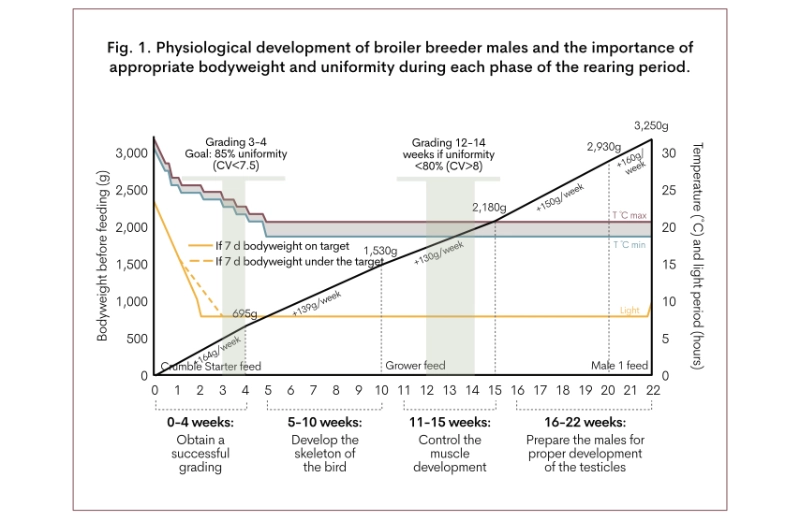
From approximately sixteen weeks onwards, reproductive organs develop rapidly, preparing males for sexual maturity and successful mating during production. Accordingly, the objective of rearing is not to maximise growth rate, but to synchronise growth with the physiological priorities of each developmental stage.
Early growth builds the foundation for lifetime fertility
The first week after hatch is one of the most biologically active periods in the life of the broiler breeder males. During this critical period, the digestive tract, immune system, metabolic organs, and skeletal framework undergo rapid growth and functional development, establishing the bird’s capacity to efficiently utilise nutrients and sustain subsequent physiological processes.
Intestinal development is particularly intense during the first week after hatch, when the gastrointestinal tract experiences its highest relative growth rate. Consequently, farm management during the first days of life should prioritise prompt access to feed and water, optimal brooding conditions, high-quality diets, uniform feed distribution, and appropriate lighting management. Importantly, the objective is not simply to maximise bodyweight but to establish uniform physiological development across the entire flock.
Uniform early growth creates the biological foundation required for later skeletal and reproductive development, and fertility.
Frame development is more important than body weight alone
Body weight has traditionally been used as the primary indicator of male quality. However, body weight alone provides only limited information regarding future reproductive performance. Frame development, particularly shank length, is a valuable indicator of skeletal growth and future mating ability.
Internal field observations have demonstrated a strong positive relationship between body weight and shank length at an early age (3 to 8 weeks of age). Interestingly, body weight at approximately eight weeks of age appears to be the best predictor (R2 = 0.7586) of adult shank length (Fig. 2). Beyond this age, the relationship gradually weakens because skeletal growth slows considerably, whereas body weight continues to increase primarily through muscle deposition.
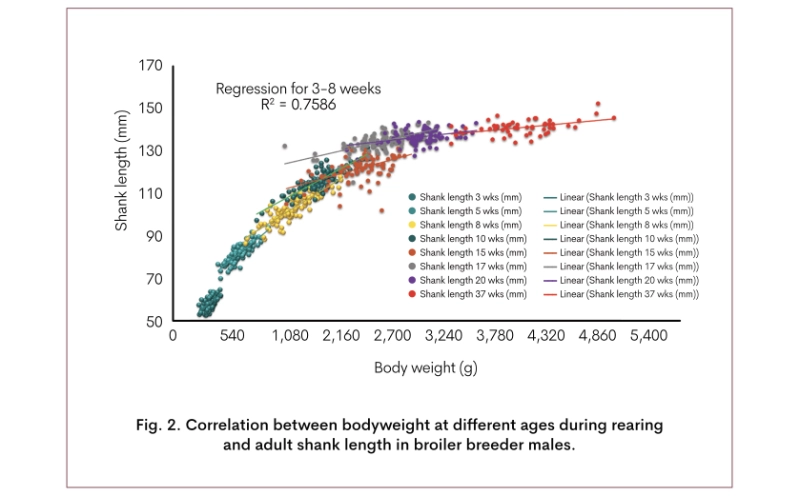
These observations suggest that inadequate growth during the early rearing period may permanently compromise frame development. Birds that fail to develop sufficient skeletal structure during the first weeks of life rarely achieve complete compensation later, even if they eventually reach the recommended body weight. Consequently, relying exclusively on bodyweight targets may mask important differences in structural development among males.
From a practical perspective, early flock grading is an effective management tool to minimise these differences. Whenever possible, small or underweight males should be identified and separated as early as possible, allowing them to receive more uniform access to feed and improve their growth potential. Additional grading before four weeks of age, and subsequently every four to five weeks, or whenever flock uniformity declines, can further improve bodyweight uniformity and reduce variation in skeletal development.
Ultimately, productive breeder males require more than simply achieving target body weight. They must develop an adequate skeletal frame capable of supporting efficient mating behaviour and sustained reproductive performance throughout the production cycle.
Early development also determines future sperm production
An equally important aspect of early development is the proliferation of Sertoli cells. Sertoli cells are responsible for supporting spermatogenesis throughout the reproductive life of the male. Their proliferation occurs primarily during the early rearing period and largely ceases before sexual maturity.
Consequently, the final number of Sertoli cells established during rearing determines the bird’s future capacity for sperm production. Unlike bodyweight, deficiencies in Sertoli cell development cannot be compensated later in life.
Poor early growth or excessive variation in flock uniformity may permanently reduce sperm-producing capacity, even when adult bodyweight appears normal. This concept reinforces an important biological principle: fertility begins during rearing, not at photostimulation.
Preparing males for sexual maturity
Between 16 and 30 weeks of age, the physiological priorities of broiler breeder males shift from skeletal growth to reproductive development, but with the risk of excess muscle development. During this period, the bodyweight trajectory becomes one of the most important determinants of testicular development, semen production, and subsequent fertility. Therefore, male body weight should remain close to the recommended growth curve with consistent weekly body weight gain relative to the target.
Males that remain below the target bodyweight after approximately 14–15 weeks of age frequently exhibit delayed sexual maturity, reduced testicular development, and lower fertility. Conversely, overweight males often develop excessive breast muscle, which can impair balance, reduce mating efficiency, and increase the risk of injury to females during mating.
Consequently, maintaining an appropriate bodyweight trajectory throughout the period from 18 – 24 weeks is essential to optimise both reproductive development and mating performance. Maintaining good male uniformity in this period is also critical, as this makes male management and feeding decisions after 30 weeks much easier to manage.
Photostimulation should only be initiated once males have reached adequate physiological maturity. It was demonstrated that males photostimulated before 16 weeks of age produced lower semen volume, reduced sperm concentration, and fewer total spermatozoa throughout the production cycle. In commercial practice, males may be photostimulated one week before the females to promote better synchronisation of sexual maturity between the sexes.
However, this strategy should only be adopted when males have achieved the recommended bodyweight, body condition, and physiological development and don’t experience environmental stressors while being housed on their own. Appropriate synchronisation of male and female sexual maturity is essential for maximising fertility, hatchability, and overall reproductive performance.
Fertility requires continuous management during production
Successful fertility management does not end when the rearing period finishes and production begins. Throughout lay, maintaining appropriate bodyweight, body condition, and mating activity is essential to sustain fertility. While the periods from 18 – 24 and 24 to 30 weeks are key for growth and testicular development, the period after 30 weeks is a holding phase where weekly growth is well managed and consistent from week to week.
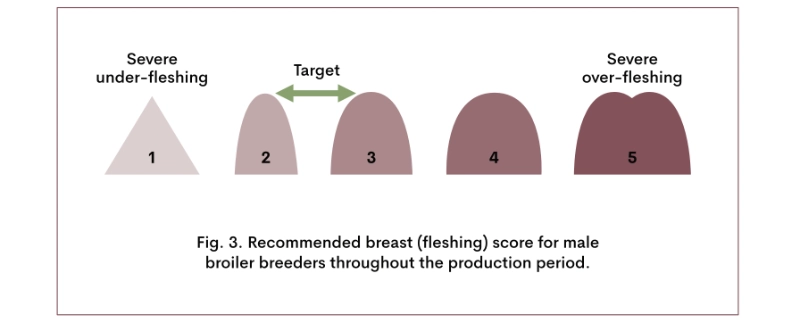
Overweight males often develop excessive breast muscle, reduced balance, and lower mating efficiency. Conversely, underweight males may show poor social dominance, delayed reproductive development, and reduced libido. Therefore, the objective during production is to maintain males in optimal body condition rather than simply maintaining bodyweight. Field observations have shown that the highest fertility and hatchability are achieved when breeder males maintain a breast score of 2 to 3 throughout the production period (Fig. 3).
Routine assessment of mating activity is also a valuable indicator of reproductive performance. Observing birds during the last four hours before lights-off, when mating activity reaches its daily peak, allows producers to evaluate mating attempts, successful copulations, and female receptivity.
Changes in mating behaviour often occur before reductions in fertility become evident in hatchery records, allowing earlier corrective management actions.
Uniformity remains one of the most important determinants of reproductive performance.
Poor uniformity creates substantial variation in body size, physiological development, and social dominance, all of which directly influence mating behaviour and fertility. Underweight males are more likely to become socially subordinate and have been reported to exhibit lower circulating testosterone concentrations than males achieving the recommended bodyweight.
As a result, they often display reduced libido and fewer successful mating attempts. In contrast, overweight males frequently develop excessive breast muscle and impaired balance, reducing their ability to mount hens effectively and complete successful copulations.
Consequently, both underweight and overweight males contribute disproportionately to reduced flock fertility. Maintaining high flock uniformity through appropriate bodyweight management and continuous monitoring of body condition throughout production remains one of the most effective strategies for maximising fertility, hatchability, and overall reproductive performance in commercial broiler breeder operations.
Conclusion
Modern broiler breeder males require a management approach that recognises their unique physiological development. Fertility is not determined by a single management practice but by a sequence of successful decisions made throughout rearing and production. Early growth establishes organ and skeletal development. Appropriate bodyweight trajectories support reproductive maturation. Correct light stimulation optimises testicular development, while continuous monitoring of body condition, mating behaviour, and flock uniformity helps sustain fertility throughout production.
Maximising hatchability in a broiler breeder operation will increasingly depend on understanding and managing the biology of the modern breeder male. Producers who integrate nutrition, physiology, and practical flock management into a coordinated strategy will be best positioned to achieve consistently high fertility, superior chick quality, and improved hatchery performance.
References are available from the author on request
