
Layer diets are formulated with considerable precision. Energy, amino acids, minerals and physical characteristics are controlled because variation in feed composition can influence bird development and production.Feed also has a microbial profile, and that profile is considerably more dynamic. Raw materials carry diverse microbial communities.
Their composition and load can change during storage, manufacture, transport and on-farm handling. Some microorganisms are part of the normal environmental microbiota. Others, including Salmonella, Escherichia coli and Clostridium perfringens, may present specific animal-health, food-safety or biosecurity concerns.
The goal of a feed hygiene program is not to sterilise the feed but to understand the microbial pressure entering the feed system, reduce organisms of concern and limit avoidable contamination or recontamination before feed reaches the bird.
Feed is a microbial input
Research has shown that poultry feeds and individual feed ingredients carry distinct microbial communities and can influence intestinal microbial colonisation and maturation. Broader poultry research also links intestinal microbiota with nutrient metabolism, barrier function and immune development. This is especially relevant during early life, when intestinal microbial colonisation and immune development occur rapidly. Early nutritional and microbial exposures influence these systems, although diet, environment, age, health status and management also contribute.
Total microbial count in feed does not directly predict egg production, and not all microorganisms carried in feed are undesirable. Rather, feed microbiology represents one component of the exposure environment presented repeatedly to the bird. This distinction matters when interpreting feed-hygiene data.
Aerobic bacterial counts provide a broad measure of culturable bacterial load. Enterobacteriaceae can provide information on hygienic status, while pathogen testing asks whether a specific organism such as Salmonella is detected in the sample tested. These measures are related, but not interchangeable.
Heat reduces microbial load, but only at one point
Thermal processing can substantially reduce microbial contamination when adequate temperature, moisture and retention time are achieved. Its limitation is temporal. Research into feed-mill contamination has identified opportunities for microorganisms to enter with raw ingredients, persist within equipment or the processing environment, and contaminate feed after thermal processing.
Coolers, conveyors, storage, load-out, transport and farm environments can all provide opportunities for downstream exposure. Layer feed creates an additional challenge because mash diets remain common. It was noted that compounded mash feeds used for laying hens may not routinely receive thermal treatment in many production systems. An effective thermal step should therefore be viewed as establishing a microbial control point rather than guaranteeing the microbial status of feed at consumption.
Treatment efficacy depends on conditions
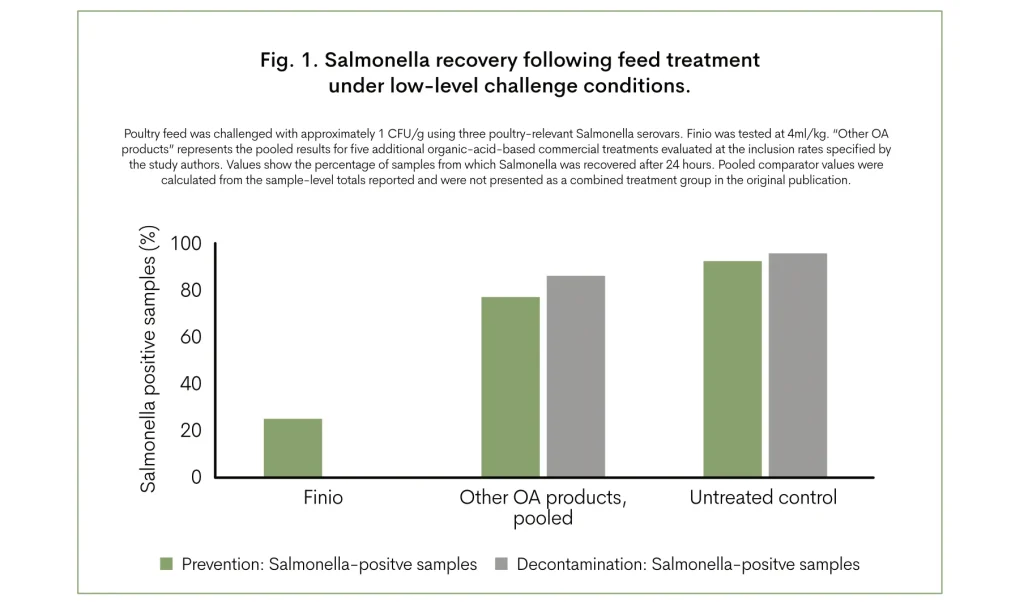
Chemical treatment provides another effective control point, but efficacy varies substantially between products and conditions. Eight commercial feed treatments were compared against three poultry-relevant Salmonella serovars in both decontamination and contamination-prevention models. The study also included a low challenge of approximately 1 CFU/g, selected to better approximate concentrations reported in naturally contaminated compound feed.
At this lower challenge, efficacy differed markedly among individual non-formaldehyde treatments. Salmonella was recovered from 25% of Finio treated feed samples, identified as OA1, in the prevention model compared with 92% of untreated samples. In the decontamination model, Salmonella was not recovered from any Finio-treated sample after 24 hours.
Earlier work showed a similar treatment-dependent response in experimentally contaminated layer mash and reported that Finio treatment of feed between 0.5 and 2.5kg/MT significantly reduced S. typhimurium levels, whilst for three other commercial organic-acid formulations, significant reductions were only noted at the highest inclusion rate tested. The practical conclusion is that no single chemistry is universally superior; formulation, dose, feed matrix, challenge level, treatment timing, contact time and application quality can all influence the observed result.
Feed-borne exposure reaches the bird
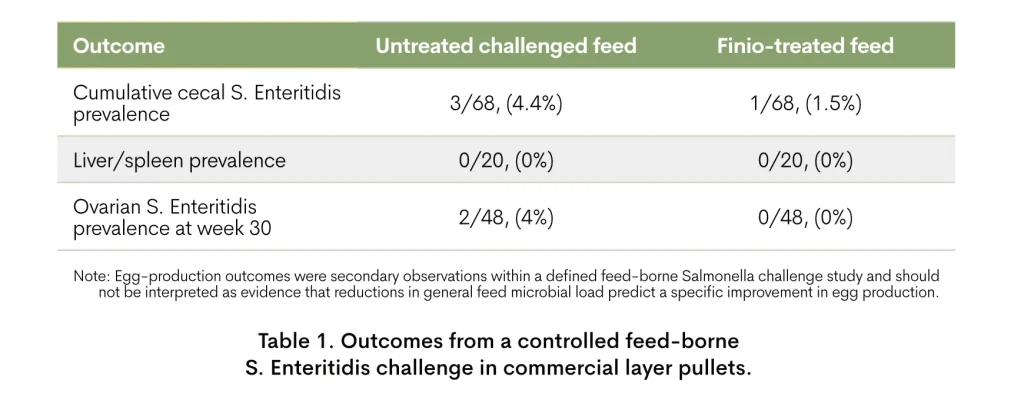
Feed-level efficacy matters because contaminated feed can become an exposure route to the animal. In a controlled commercial-layer pullet study, S. Enteritidis was introduced through contaminated material incorporated into mash feed. Finio-treated feed reduced cumulative cecal prevalence to 1.5% compared with 4.4% in untreated challenged birds, while ovarian prevalence at 30 weeks was 0% compared with 4% in controls.
Over the 13-week laying period, the Finio-treated group also produced 36 more eggs than the untreated challenged group. Egg production was a secondary outcome and should be interpreted as an associated response within a defined Salmonella challenge rather than evidence that reducing general feed microbial load will predictably increase egg output.
The production response should be interpreted cautiously. The study evaluated a defined Salmonella challenge and does not establish that reducing general feed microbial counts will produce a predictable increase in egg output. Its stronger contribution shows the feed-to-bird link: modifying microbial exposure in feed changed subsequent Salmonella prevalence in the animal.
Independent layer studies support the broader principle that interventions delivered through feed can alter Salmonella colonisation and transmission in birds. A 1.13-log reduction in cecal S. enteritidis levels and a reduction in prevalence from 72.5% to 50.0% in horizontally exposed W-36 pullets receiving a yeast-derived postbiotic was reported.
Similarly reduced cecal colonisation in directly challenged layer pullets, while others demonstrated reduced horizontal transmission outcomes using a feed-delivered bacteriophage. These interventions act differently from feed sanitation, but collectively demonstrate the biological relevance of managing microbial exposure through the feed pathway.
Managing the process, not a single result
Microbial-load data should be interpreted according to study type. Controlled laboratory studies establish antimicrobial activity under defined conditions, while commercial feed-mill studies show how microbial control performs within operating systems where application, equipment and process conditions also influence results. In commercial field evaluations, Enterobacteriaceae have been used to assess both microbiological status and application performance. In one feed-mill evaluation, Enterobacteriaceae were detected in 35% of pelleted-feed composite samples at levels ranging from 10 to 520 CFU/g, with incidence and bacterial levels influenced by application conditions. In a separate commercial field program, average Enterobacteriaceae levels in finished feed remained below 10 CFU/g during later monitoring after treatment and application parameters were optimised.
Controlled ingredient studies further demonstrate the importance of dose and matrix. In canola meal, Fortrol reduced S. Typhimurium by 23% at 1kg/MT, 52% at 4kg/MT, 74% at 8kg/MT and 87% at 12kg/MT after 24 hours. Taken together, the evidence supports a process-based approach to feed hygiene. Microbial pressure can enter with ingredients, change during storage and manufacture, decline substantially during thermal processing, and increase again through downstream equipment, handling, transport or on-farm storage.
For layer operations, effective feed hygiene therefore depends on understanding what enters the system, how effectively it is reduced, where contamination can be reintroduced and what ultimately reaches the bird. Thermal processing remains an important control, but microbial quality at consumption reflects the entire feed pathway.
The objective is not simply to reduce microbial load once. It is to maintain microbial quality from feed manufacture through to consumption.
References are available from the authors on request
