
Modern hatcheries generate an increasing volume of information. Incubation profiles, hatchability, chick yield, body temperature and quality scores can all help determine whether a flock has performed as expected. Yet alongside these measurements is another source of information that can be observed almost immediately: the behaviour of the chicks themselves.
From the moment chicks leave the hatcher, their activity, posture, distribution and vocalisation can provide valuable clues about how they are responding to their environment. Huddling may indicate thermal discomfort, while panting, altered wing position or changes in activity can signal that conditions require attention. Responses following handling or vaccination may also reveal whether processes that appear satisfactory from an operational perspective are equally appropriate from the chick’s perspective.
Behaviour alone cannot diagnose a specific problem, nor should it replace objective measurements of chick quality or environmental conditions. Its value lies in adding another layer of information. When behavioural observations are considered alongside temperature, hatch data and physical chick assessments, they can help hatchery managers identify emerging problems and investigate their cause.
As hatcheries become larger and increasingly automated, learning to recognise these signals may become more rather than less important. The challenge is turning observation into information that can support practical decisions and consistently good chick welfare.
Behaviour as a welfare indicator
Chick behaviour reflects the interaction between the animal and its immediate environment. Newly hatched chicks respond rapidly to changes in temperature, airflow, light, noise and handling, making behavioural observation a potentially useful component of welfare assessment. Unlike measurements taken at a single point in time, behaviour can also reveal how a group of chicks is responding as conditions change.
The value lies less in observing an individual behaviour than in recognising patterns. Chick distribution, activity levels, posture, vocalisation and responsiveness can all provide useful information, particularly when changes occur across a group. Chicks that are evenly distributed and alert may indicate comfortable conditions, whereas persistent clustering, restlessness or unusual inactivity should prompt closer investigation.
Interpretation, however, requires context. Chicks may naturally rest after processing, for example, while activity can vary according to age since hatch, lighting and previous handling. Vocalisation may indicate discomfort but can also occur in response to disturbance. Behaviour should therefore be treated as an early warning system rather than a diagnosis.
Combining observation with objective measurements makes it considerably more useful. Body temperature, environmental conditions, chick-quality assessments and hatch records can help determine whether a behavioural change reflects thermal discomfort, dehydration, processing stress or another factor. Used in this way, behaviour becomes part of a broader welfare assessment, helping hatchery teams identify when conditions warrant closer attention rather than relying on assumptions about what chicks are experiencing.
Temperature: watching where the chicks go
Newly hatched chicks have a limited ability to regulate their own body temperature, making the thermal environment particularly important during processing, holding and preparation for transport. Air temperature provides a useful reference, but it does not necessarily describe the conditions experienced by chicks at bird level.
Distribution can provide an immediate indication of thermal comfort. Chicks that cluster tightly or seek warmer areas may be experiencing chilling, while spreading apart, panting or holding the wings away from the body can indicate excessive heat. Uneven distribution may also reveal localised differences in airflow or temperature that are difficult to identify from a single environmental sensor.
Behaviour should be supported by direct measurements where possible. Chick body temperature, combined with measurements taken at chick level, can help determine whether observed changes genuinely reflect thermal discomfort. This is particularly valuable in holding areas and chick boxes, where stocking density, ventilation and metabolic heat production can create microclimates that differ considerably from the surrounding room.
Importantly, the response should not simply be to alter the thermostat. Persistent behavioural changes should encourage investigation of airflow, humidity, stocking density, equipment operation and the location of chicks within the holding environment.Watching how chicks distribute themselves therefore provides more than a visual welfare check. It can reveal how effectively environmental control is working where it matters most, at the level of the chick.
What handling leaves behind
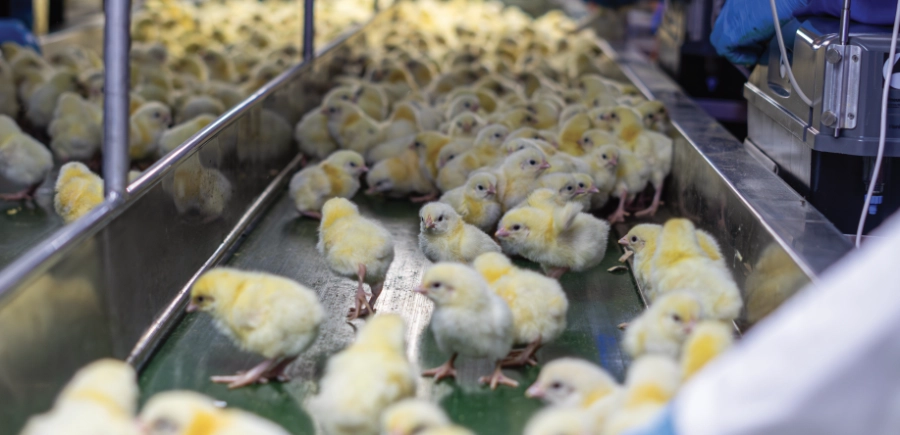
Between leaving the hatcher and entering the chick box, birds may experience several handling stages, including separation from hatch debris, conveying, grading, sexing, vaccination and counting. Modern systems are designed to process large numbers of chicks efficiently and consistently, but welfare assessment should consider not only how the equipment operates, but also how chicks respond to the process.
Transfer points, changes in direction, conveyor speeds and differences in height can all influence the physical forces experienced during automated handling. Manual handling introduces different variables, including operator technique and consistency. Neither approach is inherently better; the important question is whether the system minimises unnecessary physical stress while achieving the required processing outcome.
Observing chicks immediately after handling can provide useful feedback. Changes in activity, posture or balance, persistent distress vocalisation, visible injury or unusually prolonged recovery may indicate that a particular stage warrants closer investigation. Where a response is repeatedly associated with the same processing point, equipment settings, maintenance or handling procedures can then be reviewed.
Regular observation is particularly valuable because gradual changes in equipment performance may otherwise go unnoticed. Wear, altered settings or increasing throughput can change the chick’s experience even when the process continues to function operationally.
Assessing the chick after processing therefore closes an important feedback loop. Efficiency can be measured by throughput, but the response of the chicks helps determine whether that efficiency is being achieved without compromising welfare.
Hydration, comfort and the hatch window
Not every chick entering the processing area has experienced the same journey. Within a single hatch, some chicks may emerge considerably earlier than others, creating differences in the time spent within the hatcher before take-off. This hatch window can influence hydration, residual yolk utilisation, activity and the way individual chicks respond to subsequent handling and holding.
During the period immediately after hatch, chicks continue to rely on nutrients and water associated with the residual yolk. However, prolonged holding, particularly under inappropriate environmental conditions, can increase moisture loss and place additional demands on these reserves. Temperature and relative humidity therefore interact with time since hatch, making the condition of the chick more informative than holding time alone.
Behaviour can provide useful clues. Changes in activity, responsiveness or posture, particularly when accompanied by differences in chick quality or body temperature, may indicate that a group is beginning to experience physiological challenge. The objective is not to attribute dehydration or poor welfare to a single behavioural sign, but to recognise when several indicators point towards the need for closer assessment.
Reducing unnecessary variation begins earlier in the incubation process. Good egg storage, incubation control and hatch synchronisation can help narrow the hatch window, while appropriate conditions after hatch protect chicks until processing and dispatch. Viewing the hatch window from the chick’s perspective highlights an important point: chronological age after setting is the same across a batch, but the actual post-hatch experience of individual chicks may be very different.
From observation to measurement
Behavioural observation becomes most valuable when it is consistent enough to reveal trends. A hatchery worker noticing that chicks appear unusually quiet can provide an important warning, but recording when, where and how frequently particular responses occur makes that information much more useful for identifying underlying causes.
The challenge is to select indicators that are practical and repeatable. Chick distribution, activity, posture and vocalisation could be assessed at defined points after take-off, processing or during holding, then considered alongside body temperature, chick-quality scores, cull rates and environmental measurements. Establishing a normal behavioural pattern for a particular hatchery also makes deviations easier to recognise.
Technology may increasingly support this process. Cameras and image-analysis systems offer the potential to monitor chick distribution and activity continuously, while environmental sensors can relate behavioural changes to temperature, humidity and airflow. Automated monitoring could be particularly valuable in large hatcheries where observing every group continuously is unrealistic.
However, greater measurement does not automatically mean better welfare. Data only become useful when they prompt investigation and, where necessary, action. Experienced hatchery staff remain essential for interpreting what is happening and recognising when a response falls outside the normal range.
The opportunity is therefore not to replace stockmanship with technology, but to make behavioural observation more objective. Combining experienced observation with consistent measurements can turn subtle changes in chick behaviour into practical information for managing welfare.
Following the signal beyond the hatchery
The hatchery may lose sight of chicks at dispatch, but valuable information can still be gathered from what happens next. Conditions during loading and transport, together with the chicks’ condition on arrival, can provide important feedback on how effectively welfare has been maintained through the final stages of the hatchery process.
Chick behaviour at arrival should be interpreted carefully because transport introduces additional influences, including journey duration, temperature, ventilation and vehicle movement. Nevertheless, observations of activity, distribution, responsiveness and thermal comfort can help identify patterns when combined with information collected before dispatch.
The greatest value comes from connecting different stages of the chain. If chicks repeatedly arrive showing signs of thermal discomfort, for example, records from holding, loading and transport can be reviewed together rather than assuming the problem originated at a single point. Similarly, differences between batches may encourage closer examination of hatch timing, processing conditions or the length of the pre-dispatch holding period.
Feedback from the farm can also complement hatchery measurements such as chick quality, body temperature and cull rates. The objective is not to attribute every subsequent performance issue to the hatchery, but to create continuity of information. Chick welfare is ultimately a journey rather than a series of isolated events. Following the signals beyond dispatch can help hatcheries understand how well their processes prepare chicks for the transition to the farm – and where further investigation may be worthwhile.
Conclusion
As hatchery technology becomes increasingly sophisticated, the ability to measure and control incubation, processing and environmental conditions continues to improve. Yet welfare cannot be understood from equipment settings and production data alone. Ultimately, it is the chick’s response to those conditions that determines whether its needs are being met.
Behaviour provides an immediate and potentially valuable source of information. Distribution, activity, posture, vocalisation and responsiveness can highlight changes that warrant further investigation, particularly when considered alongside body temperature, chick-quality assessments and environmental measurements. No single behaviour provides a definitive diagnosis, but patterns observed consistently across groups can help reveal where conditions or processes may require attention.
The opportunity is not to replace established measurements or experienced hatchery management with behavioural assessment, but to connect them. From incubation and take-off through processing, holding and dispatch, each stage contributes to the chick’s overall experience.
Greater automation may make this increasingly important. As fewer decisions depend solely on direct human observation, ensuring that the chick remains part of the feedback system becomes essential. The question for modern hatcheries is therefore not simply whether processes are operating as intended, but whether the behaviour of the chicks confirms that they are experiencing them as intended.
