
In traditional hatching systems, the norm is that chicks remain in the hatchers until all chicks have hatched during the foreseen ‘hatching window’, up to 24–36 hours. After pulling from the hatchers, the chicks undergo handlings such as separation, grading, counting, vaccination, and packaging and are transported to the broiler farms. Throughout this period, the chicks usually have no access to feed and water, resulting in a total period of up to 48 hours of feed and water deprivation.
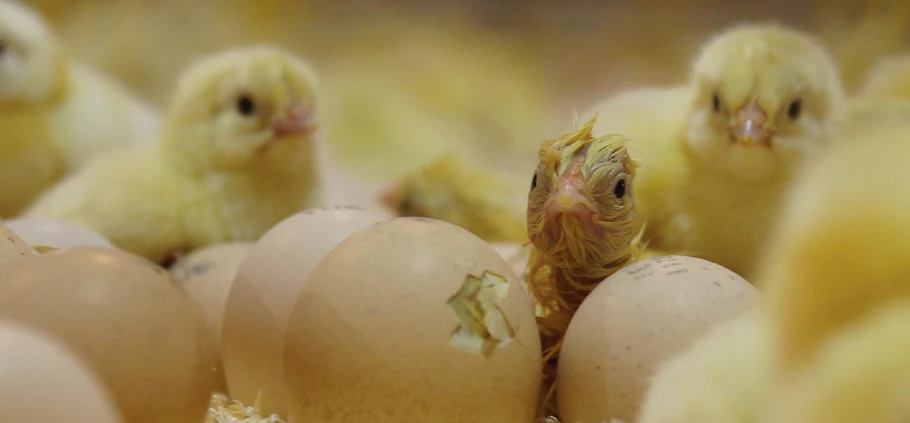
In on-farm hatching systems, eggs are brought to the broiler farm at day 18 of incubation (range is 17-19 days), where the chicks will have immediate and uninterrupted access to feed and water after hatching. Commercial on-farm hatching systems claim to have a variety of benefits in comparison to traditional hatching systems. As an example, two scientific opinions of the European Food Safety Authority (EFSA) state that transporting fertilised eggs in the context of on-farm hatching is the only manner to minimise welfare consequences during transport and on broiler farms. EFSA also emphasised that state-of-the-art animal welfare practices also help to make animals, in this event day-old chicks & broilers, healthier and that this is in line with the One Health principle. While many provide scientific support for certain positive claims made by commercial on-farm hatching companies, data regarding a lower antimicrobial use in on-farm hatching systems, compared to traditional hatching systems, are limited, and claims are mainly made based on empirical observations.
Therefore, a case study was conducted in Belgium to collect, quantify, and compare antimicrobial use in commercial flocks that were hatched using traditional hatching systems and with those hatched using on-farm hatching. The results of this study were published (Open Access) on 19 October ’23 in the scientific Journal “Animals”, with Julia G. Jerab (Faculty of Veterinary Medicine, Ghent University, Belgium) as lead author.
Materials and Methods
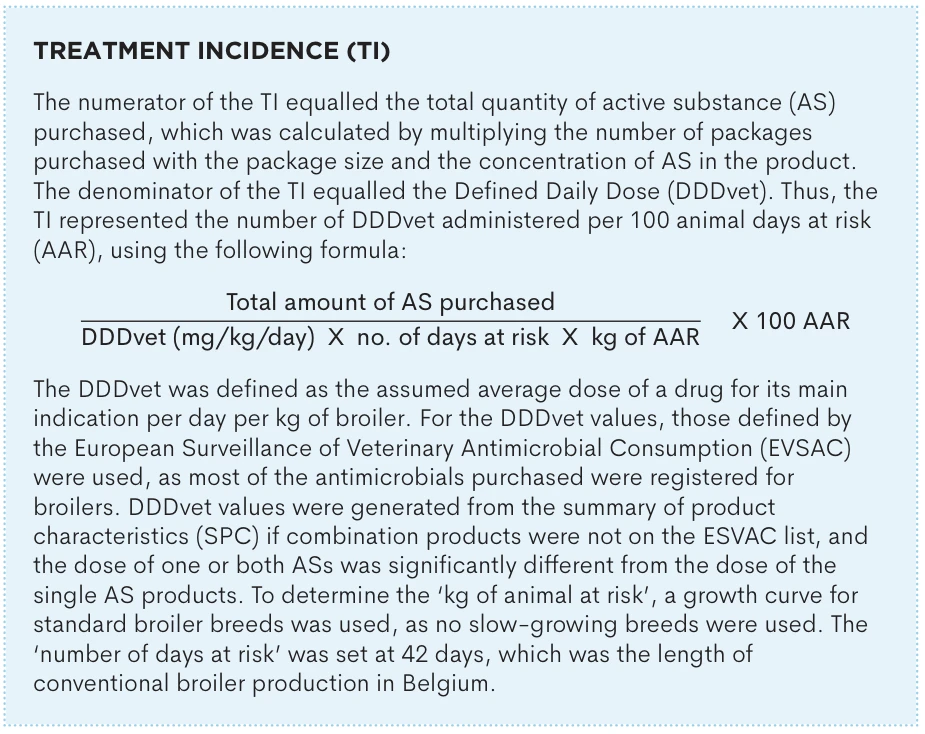
The antimicrobial use (AMU) data were collected by PEHESTAT (Lummen, Belgium) at 211 Belgian broiler farms and to quantify AMU in a standardised manner, treatment incidence (TI) was used (see box, left). Of these 211 farms, 204 farms (415 houses) applied traditional hatching methods, whereas 28 farms (54 houses) applied on-farm hatching methods. Of the 204 farms that applied traditional hatching at the start of the period of data collection (2nd of January 2020), 21 farms (36 barns) moved to on-farm hatching during this period (until 31st of December 2020). In total, the AMU data in 2244 traditionally hatched flocks and 227 on-farm hatched flocks was collected.
All farms had conventional broiler production, with no slow-growing breeds. All flocks, regardless of hatching method, were thinned once (25% of chicks at a weight of +/-2kg), and the remaining 75% were slaughtered at day 40–42, with a final weight of around 2.7kg. Vaccination did not differ between the two groups. All broiler data included in the dataset originated from two Belgian hatcheries that were both part of the same integration with common health and management amongst all broiler breeders.
Results
Antimicrobial treatment was administered in 2091 flocks (84.62%) of the 2471 total production flocks included in the dataset, with the remaining 380 antimicrobial-free production flocks. The 2091 treated flocks consisted of 1973 traditionally hatched flocks and 118 on-farm hatched flocks, leaving 12,07% non-treated traditionally hatched flocks (271) and 48.01% non-treated on-farm hatched flocks (109).
Farms using traditional hatching systems had 5.6 times higher odds of using antimicrobials than farms using on-farm hatching systems (95% CI: 3.6–8.8). When the treatment incidence in all 2471 followed production rounds, regardless of whether or not they received antimicrobials, was compared based on the hatching system, on-farm hatched flocks had a 44% lower treatment incidence (p < 0.01) (TI 8.40, CI [6.31–10.49]) compared to traditionally hatched flocks (TI 15.11, CI [14.36–15.85]). Breeder farms (p=0.19) and flock size (p=0.83) were also taken into account; however, both did not have a significant impact on the AMU. When only the treated flocks are considered, on-farm hatching flocks had a slightly lower (p < 0.01) median AMU (TI 11.69, CI [8.77–15.12]) compared to traditionally hatched flocks (TI 13.14, CI [12.60–13.71])
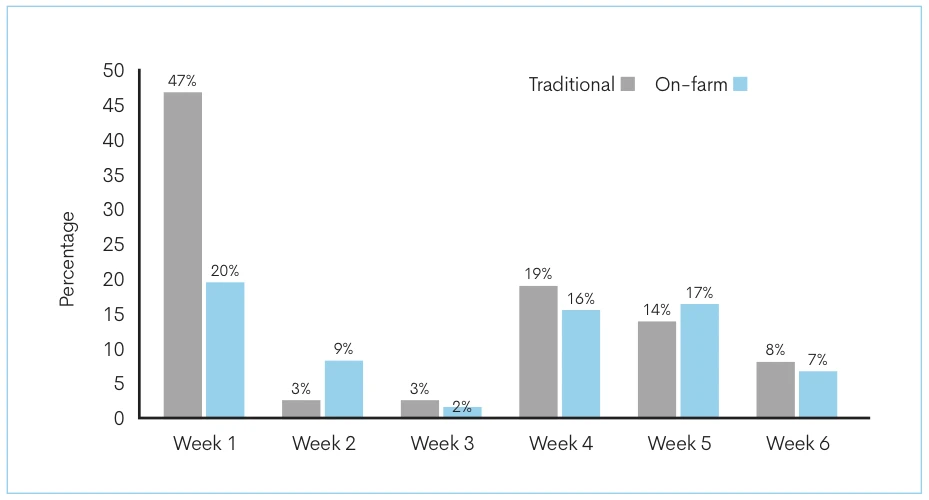
In the treated traditional production rounds, 75% of the total treatment incidence took place within the first week, compared to 51% in treated on-farm hatching rounds. Furthermore, in traditionally hatched production rounds, 37% of all antimicrobial administration took place within the first two days of the production round, more than double compared to on-farm hatched flocks (16%). When comparing the percentage of flocks that received a diagnosis resulting in AMU per week, AMU occurred in 94.62% of the weeks for traditionally hatched flocks, whereas AMU took place in 69.64% of the weeks in on-farm hatched flocks. Both on-farm and traditional flocks experienced an increase in AMU during week four, with 19% and 16% of all flocks (treated and untreated) receiving treatment, respectively (see Fig. 1).
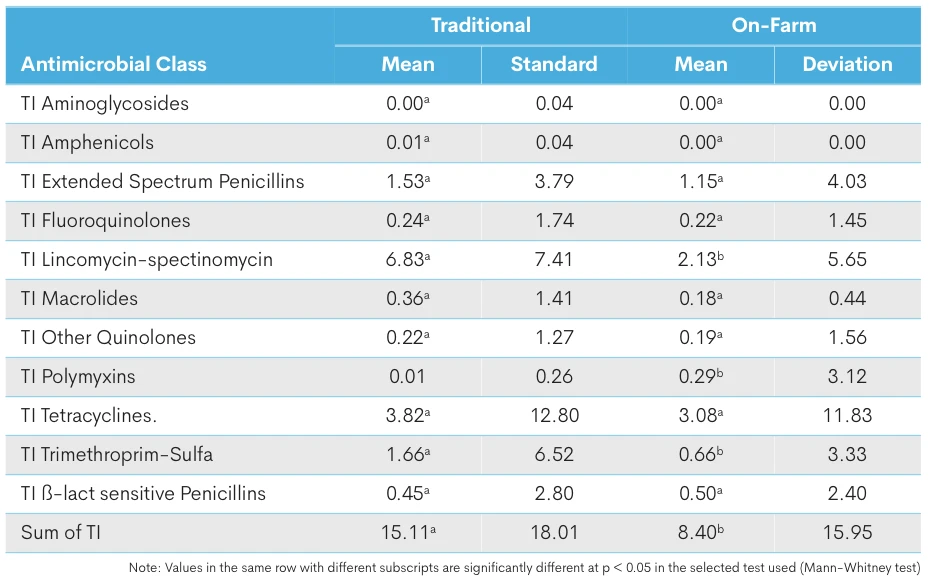
Both in traditional production and on-farm hatching, lincomycin-spectinomycin (linco-spectin) (TI 6.83, SD 7.41 versus TI 2.13, SD 5.65, respectively) and tetracyclines (TI 3.82. SD 12.80 versus TI 3.08, SD 11.83, respectively) were the most commonly used antimicrobials (see Table 1).
Linco-spectin use was three times higher in traditional flocks compared to on-farm hatched flocks.
Conclusions
In this case study, on-farm hatched flocks had significantly more antimicrobial-free flocks (48%) compared to traditional flocks (12%). As convenience sampling was used, factors such as farmer motivation could influence antimicrobial use and the percentage of antimicrobial-free flocks, nevertheless, the difference in the percentage of antimicrobial-free flocks remains considerable. In addition, on-farm hatched flocks had a significantly 44% lower treatment incidence (TI) at flock level (TI 8.40 vs. TI 15.13). Overall, the farms using traditional hatching had 5.6 times higher odds of using antimicrobials than the farms using on-farm hatching. Treated on-farm hatched flocks received three times fewer lincomycin-spectinomycin (linco-spectin) and fewer (routine) treatments at the start of the production round. These results indicate that on-farm hatching may contribute substantially to the decrease in antimicrobial use in broilers and thereby could play an important role in the future of more sustainable and ethical broiler production.
