Sow productivity is essentially measured by the number of piglets the sow can farrow over her reproductive lifetime. This relies upon the sow being able to deliver over two litters per year whilst also allowing for gestation, lactation, weaning and the wean-to-serve interval. The relentless nature of this process the high number, the size of the piglets farrowed, and the amount of milk required to feed these piglets puts immense metabolic stress on the sow.
Lactation is the most energy-demanding period for the sow, requiring around three times the energy requirements of gestation. This requirement for additional energy frequently causes the sow to enter a state of negative energy balance, whereby the energy requirements exceed the nutrient intake. This in turn causes the sow to compensate for energy losses by mobilising body reserves of fat and protein resulting in substantial body and back fat losses. Such body condition losses have downstream repercussions on reproductive performance, often increasing the wean to oestrus interval and reducing body weights and performance of future progeny. Essential oils are one alternative antimicrobial that has shown excellent efficacy without associated resistance concerns. Orego-Stim is an oregano essential oil (OEO) based supplement that has been widely demonstrated to improve growth performance, oxidative status and mitigate disease challenges in various species, facilitating optimal gut health and therefore performance.
When using a 100% natural oregano source, such as that used in Anpario’s Orego-stim range, the multitude of naturally occurring active compounds within the oil work in synergy for optimal benefits in the animal. Essential oils form the equivalent of the plant’s immune system, protecting it from predation, microbial attack, and oxidation (amongst many others). A pure whole essential oil is comprised of over 100 different active compounds such as carvacrol and thymol. Each of these active compounds serves one or multiple protective functions. Due to the numerous different activities, it is far harder for microbes to adapt and become resistant, making essential oils a viable long-term solution for supporting health and production. Orego-Stim has been demonstrated to support the growth performance and health of various livestock species and has widely been shown to enhance feed intake. As such a research trial was conducted to assess its benefits in sows during late gestation and lactation.
Study Design
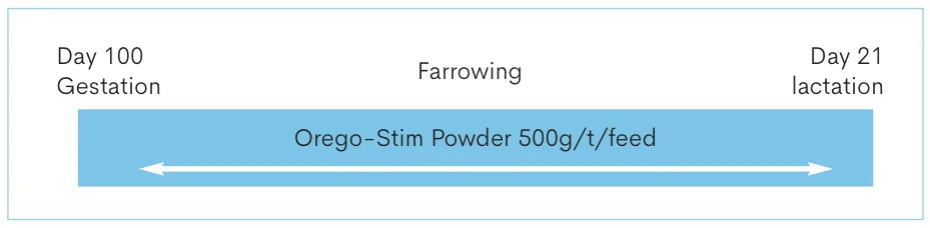
A study was designed to determine the effect of OEO on sow’s body condition and oxidative status during late gestation and throughout lactation and what impact this could have on the downstream piglet performance. The study was performed at Zhejiang University in China. 20 sows were divided into two groups (Control and Oregano) on day 100 of gestation. The control group received standard basal gestation and lactation diets throughout, and the Oregano group received the basal diets supplemented with Orego-Stim at 500g/t from day 100 of gestation through to day 21 of lactation (Fig. 1).
The sows were weighed within 24 hours of farrowing and at weaning and back fat was assessed. Piglet litter size was recorded at birth and weaning, and survival rate, piglet weights on days 0, 7,14 and 21 were recorded.
Results
The results of the study showed that sows supplemented with Oregano from day 100 of gestation weighed more at parturition than the control group and were able to maintain this weight better than the control group during lactation (Fig. 2).

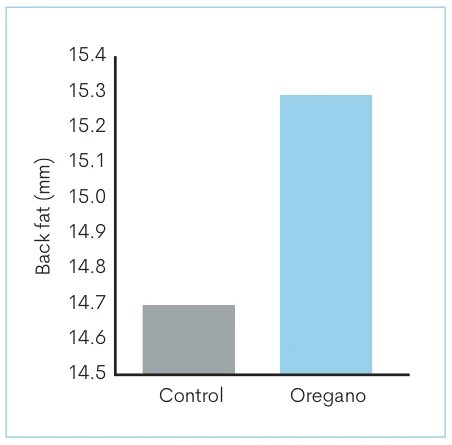
Likewise, the Oregano-supplemented sows lost less back fat than the control sows (Fig. 3).
Interestingly, the oregano sows ate less feed than the control throughout the lactation period (Table 1).
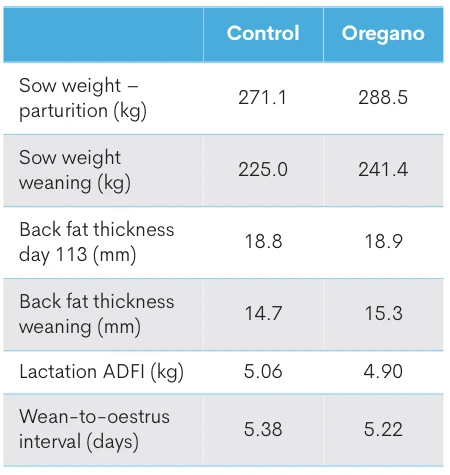
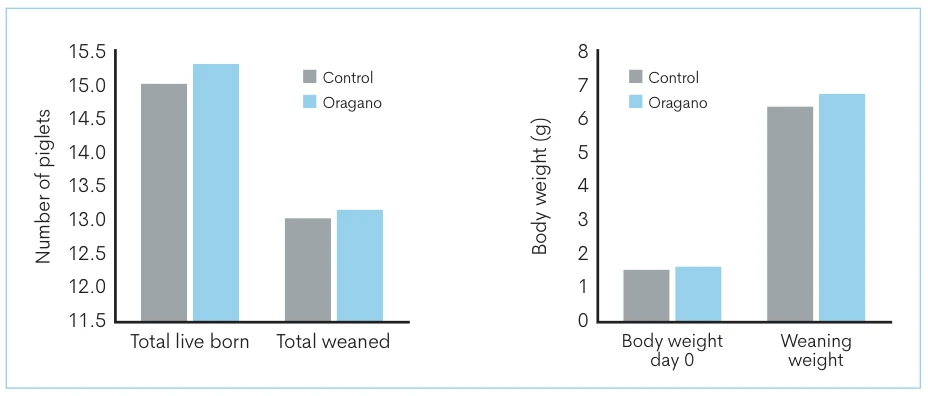
Overall, this resulted in a shorter wean-to-oestrus period for the oregano group. The piglet results showed that the oregano-supplemented sows gave birth to numerically more live piglets than the control and more piglets reached weaning (Fig. 4). Likewise, both the birthweights and weaning weights were numerically higher for the piglets from the oregano-supplemented sows (Fig. 5).
Economic Analysis
An economic analysis for both the progeny and sow was performed. Using Dr. William Close’s equation of: Every additional 0.1kg of body weight at weaning = one day less to reach slaughter weight, the analysis showed that the savings in feed costs amounted to savings of £36.18 per litter for the Orego-Stim treatment. This was due to reduced feed requirements due to reaching slaughter weight sooner (Table 2).
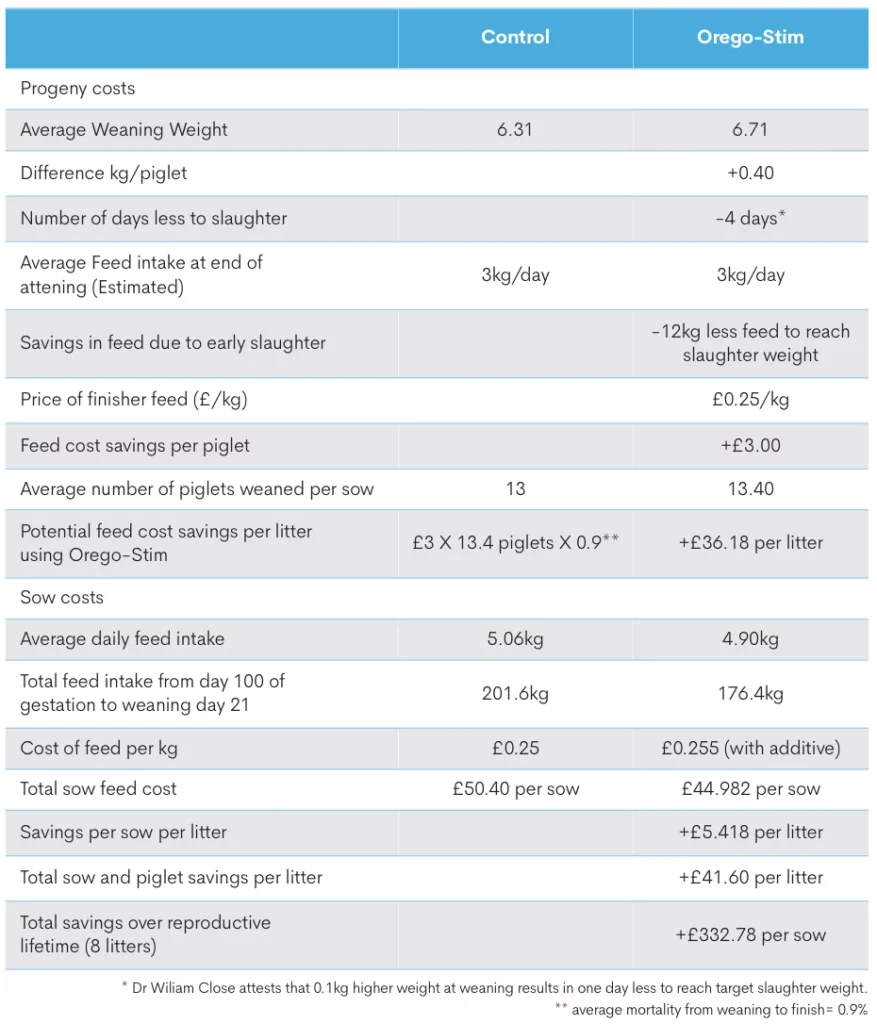
For the sow economics even when the full cost of the additive was accounted for, due to the reduced feed intake for the Orego-Stim group, feed cost savings of £5.418 per sow per litter were achieved. In total this equates to savings of £41.60 per sow, per litter, or for a sow that produces 8 litters in her reproductive lifetime, £332.78 total over all 8 litters. Overall, the results demonstrate that supplementing sows with OEO during late gestation and throughout lactation can substantially reduce the occurrence of negative energy balance, resulting in reduced losses of body reserves and a shorter wean-to-oestrus period.
Interestingly, the reduced body reserve losses are not associated with increased feed intake, which is naturally of economic benefit to producers. The improved sow performance also seems to impact the subsequent piglet quality, with higher birthrates and weights at both farrowing and weaning. The explanation for these improvements is likely due to both the improved body weights which have been shown to increase milk quality and production. The economic analysis demonstrates the value of supplementing the sow on feed costs of both the piglets and the sow, resulting in substantial feed cost savings over the reproductive lifetime of the sow. This when coupled with the reduced body and back fat losses and improved numbers of piglets born equates to substantial improvements in productivity and profitability when Orego-Stim is supplemented compared to an unsupplemented control treatment. Therefore, the supplementation of Orego-Stim can be a valuable tool in optimising the reproductive performance of the sow.
References are available from the authors on request