The post-weaning period typically results in gut health challenges for piglets. Characterised by reduced feed intake and growth, changes in intestinal morphology and gut microbiota can predispose the piglets to post-weaning diarrhoea and often reduce survivability. This period can be a “make or break” time for producers. Piglets that can’t overcome this transition are usually culled, die or can’t reach market weight, ultimately impacting profitability.
The post-weaning lag is because of a piglet’s limited ability to digest their new feed source (switching from the sow’s milk to solid feed) and absorb the nutrients from raw feed sources. Furthermore, their immune system’s lack of development during this phase of life also doesn’t contribute positively. The new feed source causes gut challenges that their undeveloped immune system isn’t prepared for, resulting in gut inflammation and diarrhoea. From a business point of view, for most swine producers and nutritionists, the post-weaning period represents poor efficiency and economic losses. Fortunately, feed additives have come a long way to support the piglet’s gut during this tumultuous time. Limiting the incidence and severity of post-weaning-related issues is essential to not only improve the efficiency of production but also the survivability, welfare and growth of the piglet beyond the weaning period.
Organic acids and piglets
Organic acids are one of the most used ingredients in pig nutrition. Thanks to their acidifying properties, they help to control bacterial and viral pathogens and impact buffering capacity in the feed, efficiently reducing gastric pH and ensuring proper digestion of dietary protein. Studies show organic acids with low pKa/acidity like formic acid or fumaric acid cover these needs in the young piglet. Acids with higher pKa, such as benzoic acid or sorbic acid, are not normally used as acidifiers, as more undissociated acid molecules will remain at low pH and fewer protons will be released in low pH environments, such as in the stomach. Data using benzoic and sorbic acids in in vitro simulation of physiological conditions in the intestinal tract using a neutral pH culture broth model showed strong antibacterial effects on E. coli and Salmonella (Fig. 1).
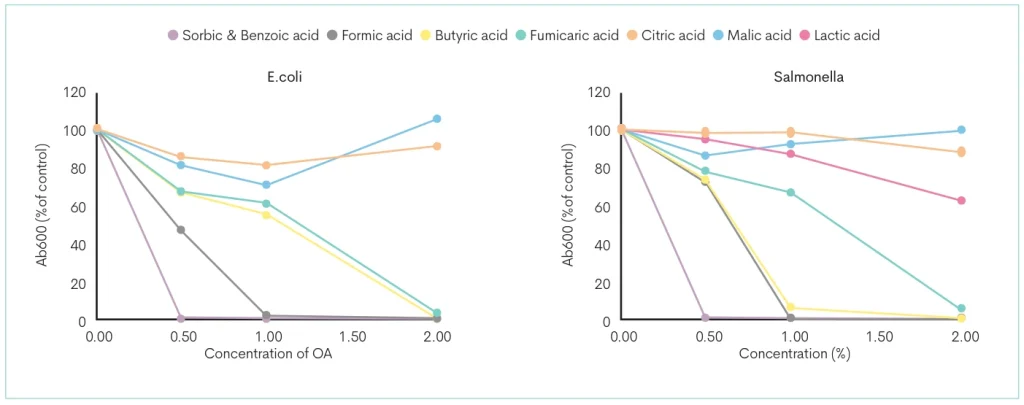
These findings can be partly attributed to the degree of dissociation in the gut: benzoic acid has more undissociated acid molecules than formic or fumaric acids at a neutral pH. Only the undissociated acid molecules can penetrate the bacterial cell, releasing its proton ion in the cytoplasm and contributing to a decreased internal pH. This results in a stressful condition for pathogenic bacteria that must pump out the protons to maintain internal homeostasis. Organic acids such as benzoic acid can create even better modulation in the lower parts of the intestine if it is properly released throughout the gut through encapsulation, as they are effective under weak acidic to neutral pH environments like those found in the gut of the animal. Studies by Novus show that by effectively protecting the organic acid in a lipid matrix using encapsulation technology, we modify the site of action and enhance the acid’s activity from the stomach through the gut.
A unique, protected source of benzoic acid
As mentioned, benzoic acid modifies the intracellular pH of gut bacteria and shifts the gut’s bacterial profile to create an environment that minimises the proliferation of pathogenic bacteria. Despite literature stating it can support gut health, free benzoic acid is inactive before reaching the hindgut, where it is most needed. This is why protecting this organic acid is critical to its success. When embedded in a fat matrix, benzoic acid is slowly released throughout the intestinal tract, allowing it to affect more of the gut and the bacteria therein. Provenia Feed Solution from Novus (PBA) is a unique, protected source of benzoic acid with an exclusive mode of action. The sophisticated manufacturing technology embeds benzoic acid homogeneously in a vegetable fat matrix, resulting in uniform granules that ensure protection of the organic acids through the stomach until reaching the intestinal tract.
Along with increased stability and reduced interaction with other dietary molecules (i.e., choline) or environmental factors (i.e., light, heat, oxidation, moisture), PBA’s benefits include:
• Reduced smell and improved palatability
• Reduced dustiness at the feed mill
• Lack of corrosion and irritability, improving handling and safety in feed mill operators
• A lower inclusion rate
Supporting piglet gut health for lifetime performance
In a study conducted at the University of Belgrade, piglets fed PBA showed an overall feed efficiency improvement of 5%. Improvements were also noted in the piglets’ gut integrity, as shown by the increase of the villi-crypt ratio throughout the small intestine and by the higher lactobacilli-E. coli ratio in the jejunum, ileum and cecum (Fig. 2).
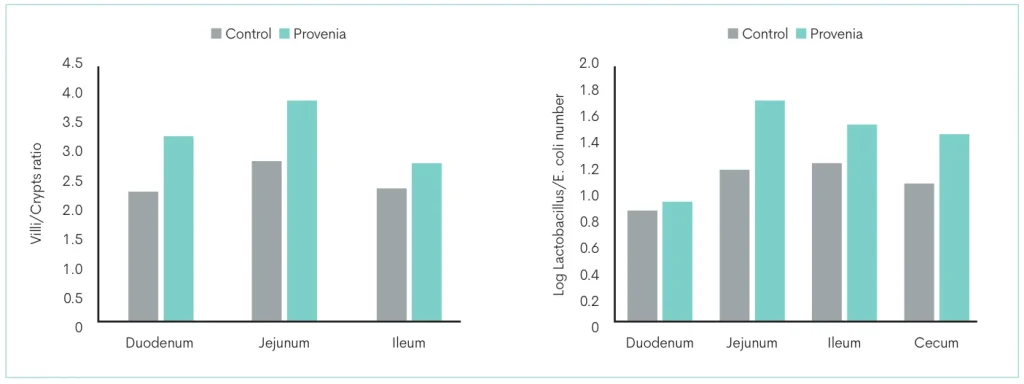
These findings align with research conducted in collaboration with the Complutense University of Madrid (Spain) and the University of Bologna (Italy), where the effect of PBA on piglet microbial profile was studied using metagenomics techniques in comparison with pharmacological levels of zinc oxide (ZnO). PBA was shown to induce an increase in alpha diversity (a parameter associated with a proper modulation of the intestinal microflora) and a proliferation of certain bacteria such as Ruminococcus, Prevotella, and Fibrobacter, all involved in the degradation of dietary fibre and the improvement in feed efficiency.
Why organic acid source matters
A piglet’s nursery stage can contribute to gastrointestinal and growth challenges, resulting in significant economic losses for the pig producer. Unlike free organic acids, protected benzoic acid does not degrade in the stomach; the fat matrix offers stability in the feed and a gradual release of benzoic acid in all compartments of the digestive tract. Producers and nutritionists looking to support piglet gut health and development over its lifetime should consider the source and composition of organic acids in the ration. Studies indicate that the PBA-protected benzoic acid as Provenia Feed Solution – helps increase piglet feed efficiency, promotes proper modulation of gut microbiota, and reduces the incidence of diarrhoea, which can result in higher profitability for swine operations thanks to fewer pharmaceutical interventions and lower piglet mortality.
References are available from the author on request