
As the poultry industry continues to juggle increasing economic and environmental pressures, reducing reliance on inorganic phosphate sources in broiler diets has become more important than ever to drive down feed production expenses, boost profit margins and improve sustainability.
Among the most effective tools in this shift is phytase, an enzyme already widely used for its phosphorus-releasing capabilities. Research now highlights the broader systemic benefits of phytase, particularly when supplemented at higher-than-usual levels.
This approach not only removes the need for inorganic phosphates like monocalcium phosphate (MCP) from early broiler diets but also supports growth performance, bone mineralisation, and improved blood biochemistry linked to oxygen transport and metabolic stability.
Why the need for phosphate reduction?
Inorganic phosphate sources such as MCP are subject to global supply volatility, high prices, and environmental scrutiny. Phosphorus runoff from livestock operations also contributes to eutrophication, so reducing or eliminating inorganic phosphate inclusion in feed addresses sustainability goals as well as providing economic resilience for producers.
Yet, achieving this without compromising bird health or performance has traditionally been a challenge since dietary phosphorus plays an essential role in bone development, energy metabolism, and protein synthesis. In broiler nutrition, meeting these needs has often involved formulating diets with safety margins of available phosphorus (avP). However, the emerging role of phytase as more than a phosphorus-releasing enzyme is aiding in how these requirements can be met.
What is phytase superdosing?
Phytase is traditionally added to diets to release phytate-bound phosphorus in plant-based ingredients like soybean meal, corn, and wheat, reducing the need for supplemental inorganic phosphorus. Superdosing refers to the use of phytase at levels significantly higher than those needed to meet phosphorus requirements.
A typical phytase dose may lie somewhere between 500–750 FTU/kg of feed, whereas a ‘superdose’ could lie from 1,500 to 2,500+ FTU/kg.
The main reason for superdosing is to maximise the breakdown of phytate; this not only improves the phosphorus availability but also mitigates the anti-nutritional effects of phytate. These include the binding of other minerals and proteins, interference with digestive enzymes, and negative impacts on gut health and metabolism. These characteristics are what make phytase superdosing an effective tool for farmers aiming to optimise bird performance and feed efficiency.
Superdosing in action
To test how far phytase can currently go, a recent study looked at broiler chickens from six to 21 days of age. Diets were corn and soybean-meal based and contained rapeseed meal and rice bran to increase dietary phytate-P content to 0.30% to ensure adequate substrate for the phytase
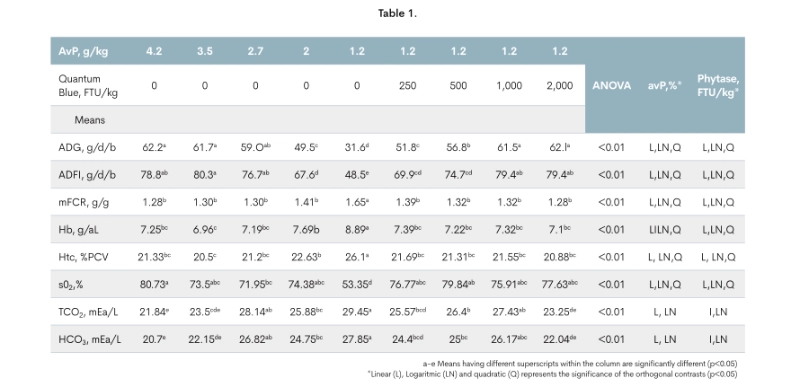
Researchers raised 360 Cobb 500 birds across nine dietary treatments: five diets with varying levels of available phosphorus (avP; from 4.2 to 1.2g/kg) and calcium, and four more where AB Vista’s Quantum Blue phytase (250 to 2,000 FTU/kg) was added on top of the lowest avP diet (1.2g/kg).
Here’s what stood out:
Growth stayed on track. Birds fed the highest phytase levels (1,000 and 2,000 FTU/kg) in phosphate-free diets grew just as well as those on the highest phosphorus diet, achieving almost identical average daily gain (62.1–62.2g/day) and feed conversion ratios.
Blood markers improved. Key indicators of oxygen transport and acid-base balance, like haemoglobin (Hb), haematocrit (Hct), oxygen saturation (sO2), total carbon dioxide (TCO2), and bicarbonate (HCO3), were all positively influenced by phytase superdosing.
Bone development wasn’t compromised. Bone parameters measured (Tibia ash weight TAW, g and Tibia Ash TA, %) indicate that Quantam Blue supplementation supports adequate bone mineralisation at the lowest available phosphorus levels.
Blood markers provide better insight into the full story
The improvements in blood markers provide a clear picture of how birds can fare on phosphate-free diets. Hb and Hct, which are critical for oxygen transport, were initially elevated in birds on the lowest phosphorus diets without phytase.
This was likely a physiological response to the reduced phosphorus levels, where the birds compensated by increasing their blood oxygen-carrying capacity. However, with phytase supplementation, these levels returned to normal, showing that phytase helps stabilise erythropoiesis (the production of red blood cells) and overall oxygen homeostasis.
Similarly, sO2, which refers to the fraction of haemoglobin bound with oxygen, was positively influenced by both higher dietary phosphorus and phytase supplementation. This means that more oxygen was being delivered to tissues, an essential factor for muscle growth and bone health. Lastly, the levels of TCO2 and HCO3, which act as markers for acid-base balance, were reduced when phytase was included. This reduction indicates better metabolic function and a more efficient regulation of the bird’s internal environment, helping to support overall health.
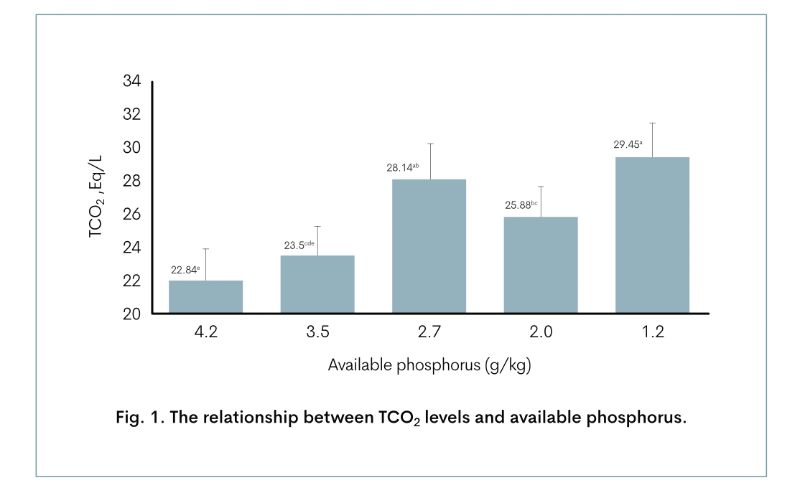
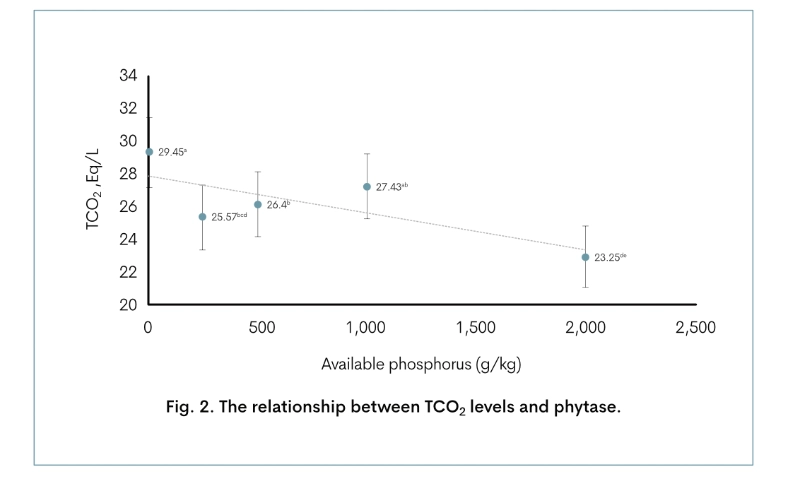
Figs. 1 and 2 show the relationship between TCO2 levels and dietary factors, with Fig.1 demonstrating a positive correlation between available phosphorus (avP) and TCO2, while Fig. 2 illustrates a negative correlation between phytase supplementation (FTU/kg) and TCO2, suggesting that higher avP supports metabolic stability, whereas phytase supplementation may enhance acid-base regulation.
Why this matters
These changes in blood biochemistry aren’t just about internal health; they also have direct relevance to meat quality and animal welfare. One of the key issues in modern broiler production is wooden breast (WB) myopathy, a muscle disorder linked to poor oxygen delivery and disrupted lipid metabolism. What’s promising is that research is showing that phytase supplementation, especially at higher doses, might help alleviate the severity of this condition.
The way phytase helps is thought to be twofold:
- First, it enhances oxygen transport by increasing erythrocyte inositol phosphate levels, which directly supports more efficient oxygen delivery to muscle tissues.
- Second, phytase reduces the negative impact of phytate, a compound found in plant-based feed ingredients that can hinder nutrient absorption and metabolic processes.
By breaking down more phytate, phytase boosts nutrient utilisation and allows for better metabolic function, leading to healthier muscle tissue and a reduction in WB myopathy.
For poultry nutritionists, the study’s findings have interesting practical implications. The data support a role of dietary Ca and avP in modulating blood biochemistry and oxygen transport. Phytase supplementation, especially at higher doses of 1,000 FTU/kg or more, can be confidently used to partly or fully replace inorganic phosphates in early broiler diets without compromising growth, bone development, or overall health. It’s clear that the benefits of phytase extend well beyond just meeting phosphorus need; it also supports the bird’s overall metabolic health – enhancing yield and meat quality.
Blood biomarkers, such as haemoglobin, haematocrit, and oxygen saturation, provide valuable early indicators of how well a diet is supporting systemic health, with phytase supplementation improving oxygenation status in birds subjected to P deficiency, especially at higher doses. These metrics give nutritionists more nuanced insights into a bird’s wellbeing, beyond traditional growth performance measures.
As environmental and economic pressures reshape poultry nutrition, phytase – especially superdosing – offers a multifunctional tool in reducing reliance on inorganic phosphate, delivering performance, sustainability, and animal welfare gains in a volatile market.
