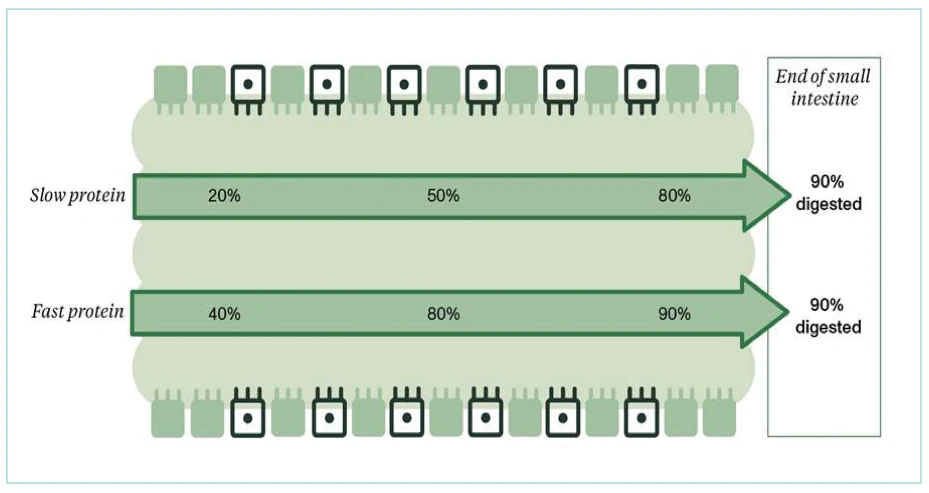
The faster a protein source is digested and absorbed, the faster it becomes available for the animals. Research now shows that faster protein ingredients are also better used for growth and performance than slower ingredients, which means less protein is wasted.
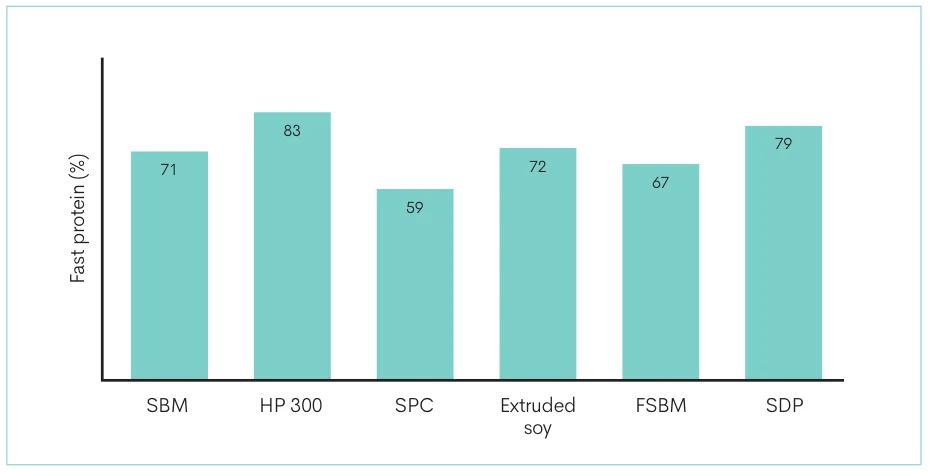
The same research shows that the fast hydrolysis of HP 300 matches most animal proteins and outperforms all other vegetable protein sources.
What is protein kinetics?
Protein kinetics refers to the dynamics of protein digestion, including the location and speed of the absorption of amino acids from the lumen of the small intestine. It considers the speed of the digestive process, the site of nutrient digestion and the postprandial bioavailability of amino acids. The protein kinetics are more indicative of feed efficiency and protein deposition than the extent of digestibility per se. Digestibility is usually used when protein ingredients are evaluated. However, the digestibility coefficient does not say anything about absorption speed.
WHY IS PROTEIN KINETICS IMPORTANT?
The quicker a protein can be digested and absorbed the quicker it becomes bioavailable and the more of the protein is going to be used. Fast absorbable protein ingredients improve nitrogen retention and feed efficiency. The rate of protein hydrolysis, the consequent rate of amino acid absorption and the synchronisation with amino acids from other protein sources are especially important in young animals.
Faster protein hydrolysis increases the protein availability for tissues, milk, and organs, and ultimately results in increased protein deposition, lower FCR, reduced nitrogen excretion into the environment and less protein fermentation in the hindgut.
VEGETABLE PLASMA IS A VEGETABLE ALTERNATIVE TO ANIMAL PROTEIN
Vegetable plasma is used in stages of life where highly digestible ingredients are needed, for instance in the diets of young animals that do not yet have full digestive capacity. It can be used in swine, poultry, pet, and aqua diets. It is called vegetable plasma because it has very similar properties as plasma; high digestibility, fast protein, and low in ANFs, but with the benefit of being a vegetable alternative and thus safe to use. It is made from enzyme-treated soybean meal and is called HP 300. Vegetable plasma in the form of HP 300 can be used as a replacement for animal proteins like blood plasma, fish meal or whey proteins in diets for swine, poultry, pet -and aqua species.
It is a cost-effective alternative to animal proteins. Vegetable plasma can also be used when biosecurity is a concern. As it is made from enzyme-treated soybean meal there is no risk of disease transfer when using HP 300. Vegetable plasma can also be used as an all-vegetable alternative for animal proteins when the use of animal proteins is not acceptable.
Vegetable plasma benefits
Vegetable plasma contains almost no ANFs: Replacing animal proteins with HP 300 does not increase the level of antinutritional factors (ANFs) in the diet. Vegetable plasma is a fast digestible protein source like spray-dried plasma (SDP) and whey protein are: Replacing whey protein and SDP HP 300 ensures equally fast protein digestion. Vegetable plasma delivers high growth performance: Replacing animal protein with HP 300 results in similar growth. Vegetable plasma is more economical than most animal proteins: Replacing animal proteins like whey protein and SDP with HP 300 reduces total feed costs.