
Feed is now one of the biggest pressures in the dairy sector, accounting for nearly 70% of the total production costs in many systems. Ruminant producers also face scrutiny over the environmental impact of livestock systems, with animal feed contributing to more than 50% of emissions at the processor and retailer level.
To ensure profitability and to meet environmental commitments, improving feed efficiency is essential, and this is placing a greater emphasis on the need for precision nutrition. The latter is closely related to having accurate information on the ingredients’ nutrient content.

Wet chemistry is often regarded as the gold standard in feedstuff analysis; however, this is costly and time-consuming. As an alternative, instead of being measured directly, nutrients can be predicted by Near Infra-Red (NIR) spectroscopy, which offers a rapid, non-destructive method of analysing feedstuffs.
The starting point for achieving high feed efficiency targets is understanding the forage quality and nutrient content.
The forage variability challenge
Although ruminants are uniquely capable of converting fibre-rich, non-human edible feeds into valuable nutrients, plant cell wall digestibility is often below 50% and is strongly related to the quality and nutrient characteristics of forages.
The nutrient profile of forages can be extremely variable due to climate and growing conditions, season, harvesting, conservation, and processing.
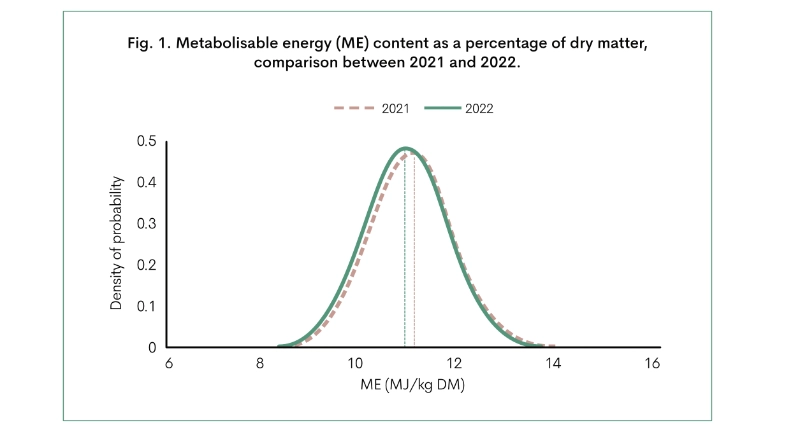
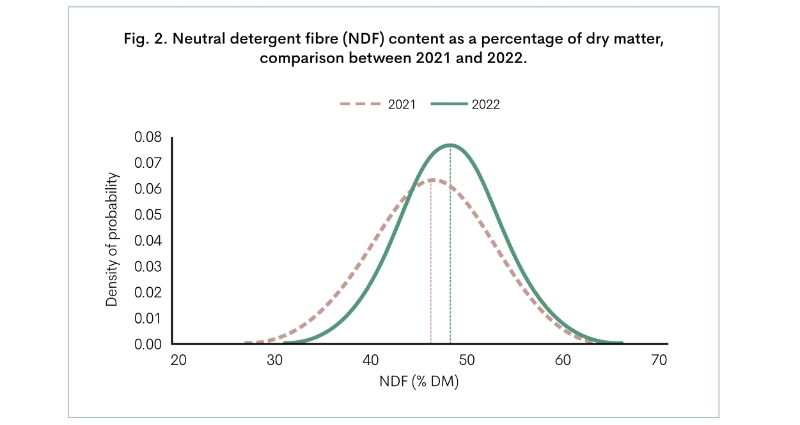
Therefore, the key to ration success comes from making an accurate characterisation of the quality of the forage, which in turn allows proper ration optimisation without risk of energy shortfalls, compromised rumen function, and reduced feed efficiency. When analysing forage by NIR, it is possible for nutritionists to quickly adjust the formulation. For example, AB Vista compared the quality of grass silage from the UK in 2021 and 2022.
Fig. 1 shows the lower metabolisable energy (ME) content as a percentage of dry matter, and Fig. 2 shows neutral detergent fibre (NDF) content as a percentage of dry matter, which were promptly noticed upon harvest with the NIR. This coincided with a dry season in 2022, which negatively impacted the ME content of grass silage, while the NDF level was higher compared to 2021.
Small deviations in forage dry matter or energy content can lead to underfeeding or overfeeding key nutrients.
Overestimation of NDF may result in insufficient structural fibre, increasing the risk of rumen pH instability. On the other hand, overestimated forage energy can compromise milk yield and increase reliance on purchased feeds. Because of this variability, it is clear to see the advantages of regular, rapid forage analysis using tools such as NIR.
Data-led efficiency
The true value of NIR is not just the speed of analysis, but how quickly the results flow into feed decisions to enable precise adjustments to be made to rations before performance is impacted.
A successful NIR-led workflow involves four steps:
1. Frequent forage scanning
Scanning silages and forages during ensiling, storage, and feed allows for changes in dry matter, fibre fractions, and energy content to be captured in real-time. This enables timely ration corrections before performance is affected.
2. Immediate ration refinement
NIR results can be fed straight into farm or mill-based formulation software. This ensures that dairy rations align with the actual nutrients available in the clamp rather than outdated or assumed values. Stabilising the forage component helps maintain a consistent energy supply to the rumen.
3. Connecting analysis to performance indicators
Using milk yields, milk solids, intakes, refusal weights, and rumen health indicators alongside frequent NIR data creates a feedback loop between forage quality and herd performance. This approach allows for targeted nutrition based on current ration conditions.
4. Incorporating broader feed quality support
NIR is part of a wider technical services network that includes laboratory analysis and feed manufacturing support. These services can help validate quality control at feed mills, ensuring consistency across raw materials and finished feeds.
These steps establish how quickly forage intelligence helps in improving ration accuracy and supporting precision nutrition and consistency in milk production.
Making more from forage
While forage remains the most cost-effective and sustainable feed resource on dairy farms, its value and impact depend on how effectively the nutrients are utilised. The ability to refine the ration quickly based on the real nutrient profile of the feeds can help to avoid unnecessary supplementation and ensure cows receive the optimal diet.
With NIR providing rapid, real-time analysis and a closed feedback loop, nutritionists can close the gap between variable forage quality and formulated values.
This supports more consistent rumen function, enhancing herd performance while keeping feed costs under control and, ultimately, strengthening the farm’s overall profit margins.
Aligning ration formulation with the exact nutrient profile can reduce waste and unlock meaningful financial gains.
Supporting lower‑carbon milk production sustainably
Accurate, timely forage analysis also supports environmental goals. Optimising ration formulation with real-time data can help reduce safety margins and reliance on higher-emission purchased ingredients, while lowering the carbon footprint of milk production and supporting more stable rumen function.
By turning forage variability into actionable insight, NIR can enable nutritionists and producers to align rations with current fibre fractions, energy levels, and dry matter. This supports consistent herd performance, protects margins, and helps dairy businesses move toward their net-zero goals.
A clear pathway forward
Feed costs and sustainability pressures show no signs of easing. In that context, a disciplined and data-driven approach that utilises tools like NIR offers one of the most effective pathways to more profitable, resilient, and lower-emission dairy production.
As NIR technology develops, it will open the door to more advanced calibrations, deeper nutritional insights and improved forecasting, supporting better decision-making.
